
The hosting question arrives sooner than most B2B teams expect. You have a working AI feature, a few customers, and a growing list of reasons not to send every request to the same place. Maybe procurement wants a tighter data boundary. Maybe the API bill is no longer pocket change. Maybe a customer asks for a private deployment. Maybe the open-weight model everyone is talking about looks good enough that buying GPUs feels inevitable.
That is when teams usually ask, “Should we use a managed API, host an open model, or run the whole thing ourselves?” It sounds like a model question. It is really an ownership question.
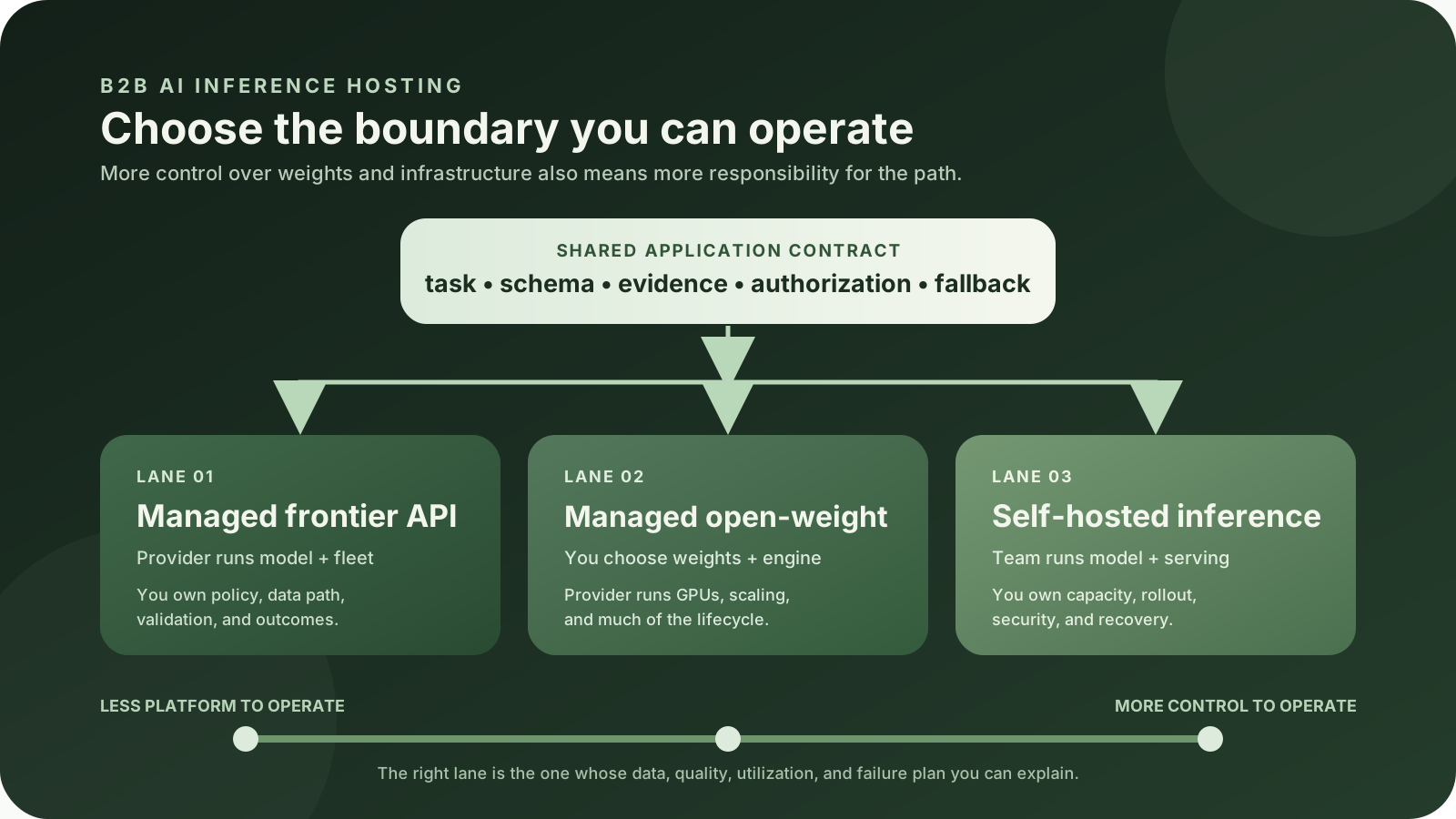
My short recommendation: start with a managed frontier API while the workload, quality bar, and demand shape are still uncertain. Consider a managed endpoint for an open-weight model when you need more control over model choice or portability but do not want to own the serving platform. Self-host inference only when you can name the control you need, show that the workload will keep the hardware busy, and staff the operational work that comes with it.
That recommendation is intentionally boring. It leaves room for a hybrid system, and hybrid is often the grown-up answer: a managed model for complex reasoning, a private or open-weight model for a narrow high-volume task, and a human or deterministic fallback when the consequence is too high for an uncertain output.
The short answer: decide what you are willing to operate
There are three useful lanes for this decision. They are not three labels for the same thing, and the phrase “open source AI” does not tell you which lane you are in.
| Lane | You choose | The provider or team operates | Best first fit |
|---|---|---|---|
| Managed frontier API | Provider, model family, request settings, data controls, and application policy. | Model weights, accelerators, serving fleet, scaling, and much of the model lifecycle. | Uncertain product work, complex reasoning, bursty demand, and teams that want to learn the job before building a platform. |
| Managed open-weight endpoint | Model weights or repository, engine options, region, hardware class, and replica policy. | Cloud infrastructure, container lifecycle, much of the networking, scaling, and health monitoring. | A known open-weight model, a stronger portability requirement, or a narrow task where you want more control without a GPU on-call rotation. |
| Self-hosted inference | Model, weights, runtime, hardware, network, storage, rollout, and operational policy. | Your platform team owns capacity, upgrades, failures, security, observability, and recovery. | Steady high utilization, hard isolation, air-gapped or special network requirements, or a model-serving capability that is itself part of the product. |
The decision is not permanent. You can begin in lane one, add a model gateway, and later move a single task to lane two or three. You can also keep a managed API as a fallback after adding a private model. What makes the move expensive is not usually changing one URL. It is discovering that your prompts, output assumptions, tool calls, latency expectations, customer contracts, and evaluation set were all quietly shaped around one provider.
If you are building an AI agent or workflow, the boundary matters even more. The model may select a tool, ask for more context, produce a draft, or request an approval. The hosting choice changes how you measure latency, how you investigate a failure, where request data is retained, and who can stop the system when a serving dependency misbehaves. The broader model-routing guide covers the choice among models at runtime. This article is earlier in the stack: who runs the model path in the first place?
What the three lanes actually mean
Managed frontier API
A managed API gives your application a network boundary to a provider-managed model service. You send a request, receive a response, and rely on the provider to operate the difficult middle: accelerator scheduling, model loading, fleet capacity, patches, model safety systems, and usually a large part of the reliability story.
That convenience is not a lack of control. It is a different control surface. You can still define tenant boundaries, minimize context, redact fields, choose a region when available, configure retention options, version prompts, set budgets, validate tool arguments, and keep an audit record in your own system. You can also choose not to send a particular class of data at all.
The tradeoff is that you do not own every layer of the data path or model lifecycle. A feature such as stored conversations, file search, managed agents, prompt caching, or a provider-side evaluation system may have different retention behavior from a stateless request. A new model may have a different safety, latency, or data policy. A provider may retire a model or change which controls are available.
That is not an argument against managed APIs. It is an argument for treating provider documentation and commercial terms as part of your architecture. OpenAI’s current data-controls documentation separates abuse-monitoring logs from application state and says eligibility for stronger retention controls varies by endpoint. Anthropic’s current platform documentation likewise describes Zero Data Retention coverage by feature and lists model-specific exceptions. Read the path you will actually use, not the shortest privacy sentence on a marketing page.
Managed open-weight endpoint
A managed open-weight endpoint is the middle lane. You select an available model and often get more say over the model revision, accelerator, region, engine, replica count, and scaling policy. A hosting provider takes the chosen weights and serving runtime and exposes them through an endpoint.
Hugging Face describes its Inference Endpoints in exactly these terms: the customer chooses the model and engine while the service provisions infrastructure, deploys the container, and manages lifecycle, scaling, and monitoring. That can be a useful compromise. You can test a smaller model for a fixed extraction or classification task without also becoming the team that maintains a Kubernetes GPU fleet.
But managed open-weight does not mean local. If the endpoint is in someone else’s cloud, prompts and outputs still travel to an external service. The model license does not define the endpoint’s retention policy, network path, logging, support process, or availability. The provider’s OpenAI-compatible API does not prove that the provider’s error semantics, context window, tool behavior, or latency resemble the original model’s other deployments.
Think of this lane as your chosen model on someone else’s serving platform. That is valuable. It is also a contract you need to inspect.
Self-hosted inference
Self-hosting means your team owns the serving path closely enough to control the infrastructure. That might be a GPU in your own facility, a private cloud account, a dedicated cluster, or a customer-controlled environment. The exact location matters less than the responsibility: your team owns model delivery, runtime versions, capacity, network security, readiness, rollout, monitoring, and recovery.
Running a local command that returns a response is not yet self-hosted production inference. Production serving needs a stable endpoint, authentication, request limits, queue behavior, model loading, health checks, capacity planning, logs, metrics, backups or reproducible artifacts, and a plan for what happens when the GPU, driver, model file, or scheduler fails.
The vLLM Production Stack is a useful reality check. Its reference architecture includes a serving engine, a request router, a Prometheus and Grafana observability layer, Kubernetes deployment, pending-request metrics, time-to-first-token, running-request counts, and GPU cache signals. That is not busywork added by a vendor trying to sell you something. It is the shape of the problem once other people depend on the endpoint.
“Private” is a data-path question, not a model-label question
Privacy is the most common reason people reach for self-hosting, and it can be a good reason. It is also the easiest reason to state too loosely.
Ask four separate questions:
- Where does the request travel? Include the application server, retrieval service, model provider, logging system, support tooling, and any cross-region inference path.
- Who can retain or inspect it? Separate ordinary application state, abuse-monitoring data, debugging logs, human review, analytics, and customer-visible history.
- What does the model feature store? A stateless chat request, a file upload, a managed conversation, an agent session, and a vector store can have different retention and deletion behavior.
- What happens when the system fails? Error logs, traces, retries, screenshots, dead-letter queues, and support exports can copy the sensitive content after the “model call” is over.
A managed service can have strong controls. OpenAI documents that API data is not used to train models by default and describes approval-based Zero Data Retention and Modified Abuse Monitoring options, with endpoint-specific limitations. Anthropic documents a Zero Data Retention arrangement for eligible API features while also stating that some stateful products and certain models have different rules. AWS Bedrock’s documentation describes per-region retention settings and model paths that may retain prompts and completions within the AWS boundary for up to 30 days. These are useful controls, but they are not interchangeable promises.
Cloud-managed does not automatically mean your data leaves your chosen cloud account in the same way that a direct provider API does. Google, AWS, Microsoft, and model providers offer several deployment paths. Some paths use regional processing. Some use cross-region routing. Some add provider-side safety or review. The right question is not “Is this cloud?” It is “For this model and feature, where can this payload, derived data, and operational log exist?”
Self-hosting reduces one class of external transfer, but it does not solve the entire privacy problem. Your application still has logs. Your observability system still has labels and traces. Your operators still need access. Your backup system still copies disks. A private GPU cluster with broad administrator access and unlimited prompt logging may be a worse data boundary than a managed service with narrowly configured retention and strong audit controls.
For a real buyer conversation, make a one-page data-flow map. Put the sensitive fields on the left, then draw every system that can receive them. Mark region, retention, access, deletion, encryption, and whether the system is optional. If you cannot draw the map, you are not ready to claim that any hosting lane is private enough.
Open weights change the choice, but they do not make providers identical
Open-weight models are appealing because they turn the model into an artifact you can inspect, download, evaluate, and potentially run in more than one place. That is real leverage. It can reduce dependence on one model vendor, make private deployment possible, and allow a narrow model to be optimized for a task.
There are two traps.
First, open-weight is not one license. A model repository can carry a permissive license, a custom community license, a research-only restriction, geographic conditions, or obligations that differ from the code around it. Hugging Face’s model-card documentation treats license, intended use, limitations, datasets, base models, and evaluation results as explicit metadata because they are part of responsible model use. Read the exact model card and license for the exact revision you plan to serve. Do not use “open” as a shortcut for “commercially unrestricted.”
Second, the same model name is not the same production service. A hosted open-weight endpoint is shaped by quantization, runtime version, tokenizer behavior, context limit, batching policy, queueing, region, rate limits, tool-call support, error semantics, and provider pricing. A current measurement study makes this point directly: the operational unit is a provider-specific service object, not only a model artifact.
That distinction matters for agents. If an agent expects strict tool arguments, a particular stop condition, or a stable JSON shape, “the model supports tool calling” is not enough. You need to test the actual endpoint with the actual tools, retries, context sizes, and refusal cases. A model that produces a nice answer in a playground can still be a poor fit for a long-running workflow.
Open weights are therefore most useful when you carry a portable contract alongside them: input schema, output schema, tool schema, evaluation cases, max context, timeout, retry behavior, model revision, license record, and known failure modes. The weights may move. Your definition of good behavior should not disappear with them.
Quality and control: what do you actually need to own?
“We want more control” is not specific enough to select infrastructure. Name the control.
| If the real need is... | Start by considering... | Do not assume... |
|---|---|---|
| Stronger data minimization or a known region | A managed path with verified retention, region, access, and network controls; then compare a private endpoint. | Self-hosting automatically removes logs, backups, or privileged access. |
| Better output quality on a narrow task | A matched evaluation across a frontier API, a smaller open model, and deterministic or human fallback. | More model ownership means better answers. |
| Predictable latency | Measure queue time, time-to-first-token, generation time, concurrency, and cold starts in the target path. | Private infrastructure is always faster; an overloaded private GPU can be slower than a managed fleet. |
| Model portability | A provider-neutral application contract and replayable evaluation set. | An OpenAI-compatible URL makes behavior interchangeable. |
| Lower unit cost | Loaded cost per successful business outcome at realistic utilization. | Per-token price or theoretical GPU throughput is the whole cost. |
| Customer-controlled deployment | A scoped private or customer-hosted lane with explicit support and upgrade boundaries. | A downloadable model means a customer deployment is easy to maintain. |
The quality question is also broader than “which model scores higher?” A B2B workflow can fail because the model chose the wrong tool, because retrieval returned stale context, because a timeout caused a duplicate write, or because a reviewer cannot see why the answer was accepted. A hosting choice should be evaluated against the whole job, just as the B2B AI evaluation guide recommends.
For an agent, record at least:
- the model and revision that answered;
- the provider or self-hosted route;
- the input and output contract version;
- tool calls, arguments, and results;
- queue time, time-to-first-token, total latency, and retries;
- validation results and human corrections;
- the final business outcome or explicit abstention.
That receipt makes the hosting decision measurable. Without it, an API move and a model move can look like a mysterious quality change.
The economics: utilization beats ideology
Managed APIs turn a large part of infrastructure into a variable cost. You pay for calls, tokens, time, or a service tier. Self-hosting turns more of the bill into fixed or semi-fixed capacity. You pay for the GPU whether it is busy or waiting, then add storage, networking, power, cooling, observability, on-call time, deployment work, and the cost of a second instance if the first one cannot be the only point of failure.
A simple loaded-cost model is more useful than a slogan:
For a managed API, the first term is visible and the rest can hide in application code. For self-hosting, the first term may look attractive while the operational terms grow. For a managed open-weight endpoint, you pay for dedicated or autoscaled capacity and still need to account for cold starts, model updates, and provider-specific limits.
Utilization is the hinge. An API can absorb a burst and charge you for the work you actually send. A private GPU can process work cheaply when it is busy, but an idle GPU does not become free because the model is open. A team that has one large burst on Monday and quiet traffic for six days may prefer a managed service even when the monthly token estimate looks large. A team with a stable, predictable, high-volume classification lane may justify a dedicated endpoint or private cluster.
The OECD’s 2026 report on AI openness is useful because it refuses to make a small-workload hosting claim sound universal. Under its assumptions, private hosting does not break even for the small scenario, takes roughly 30 months in a medium scenario, and reaches break-even much sooner for large and very large workloads. Those numbers are not a quote for your architecture. The report uses particular model prices, GPU requirements, capital costs, utilization assumptions, and operating costs. Its valuable conclusion is the shape of the curve: fixed infrastructure needs enough work to stay busy.
Public practitioner discussions point at the same issue from another angle. One r/mlops post presents a self-reported break-even estimate and says the deciding variable is how busy the GPU stays. Another r/LocalLLaMA contributor publishes a local-server cost breakdown while warning that depreciation and omitted infrastructure costs can distort API comparisons. These are not benchmarks. They are useful signals about the questions a real worksheet must answer.
Use your own traffic shape. Do not average away the peaks. Record:
- requests per minute by hour and day;
- input and output token distributions, not only their averages;
- peak concurrency and queue time;
- model load time and scale-up time;
- retries, timeouts, and failed or duplicate work;
- human review minutes per accepted result;
- GPU utilization, power, and memory headroom if you operate capacity;
- the cost of keeping a second route warm enough to recover.
If you cannot estimate those values, the correct decision may be to postpone self-hosting. Uncertainty is a reason to run a pilot, not a reason to buy a server.
Self-hosting turns inference into a product you operate
The phrase “we can run the weights ourselves” skips the day-two work. The first successful response is the easy screenshot. The real system begins when traffic changes or something breaks.
Capacity and readiness
Model loading can take long enough to change your user experience. A scale-to-zero endpoint may save idle cost and then return a transient error or a long cold start while the model initializes. A self-hosted runtime may report that the process is alive before the model is loaded, the GPU is healthy, or the route can produce a correct response.
The vLLM cold-start roadmap frames this as a complete activation path: runtime delivery, model delivery, readiness, artifact identity, measurements, and fallback behavior. That is the right mental model. A health check that only asks whether port 8000 is open does not tell you whether the inference service is ready for customer traffic.
Observability and cost attribution
You need to know whether a slow request waited in a queue, waited for model startup, spent time in prefill, generated tokens slowly, or retried through a fallback. vLLM’s per-request metrics include time-to-first-token, queue time, generation time, inter-token latency, and throughput, with a warning that collecting per-request metrics can add CPU overhead at high concurrency. That warning is healthy: observability has cost, so measure it along with the thing being observed.
For a B2B product, aggregate latency is not enough. Segment by tenant, model revision, request class, prompt size, and route. A small customer-facing answer and a long internal batch task should not share one “average latency” dashboard.
Updates, failures, and rollback
Model weights, runtimes, drivers, quantization settings, and prompts can all change behavior. Pin the model revision. Record the container or runtime version. Warm a new instance before sending traffic. Run the evaluation set. Keep the previous path available long enough to roll back. Define what happens if a model download succeeds but the process fails before readiness, or if the new model answers but produces invalid tool arguments.
The same discipline applies to a managed endpoint, although the provider owns more of the platform. Managed does not mean invisible. You still need to know which revision is serving, how long a scale-up takes, whether a request can be retried safely, and how to respond when a provider changes a model alias.
Security and access
A private endpoint needs authentication, network segmentation, secret rotation, rate limits, tenant isolation, resource quotas, image and model supply-chain checks, and a plan for admin access. The model repository itself may be gated. The runtime image may include dependencies. The observability system may receive sensitive prompts. The safest design is not the one with the most components; it is the one where each component has a small, explicit role and a tested access boundary.
For agentic workflows, keep model inference separate from action authorization. A private model is not automatically trusted with a write tool. The application should still verify the user or service identity, validate typed arguments, enforce policy, require approval where appropriate, and record the action. Hosting changes the place where inference runs. It does not turn model output into permission.
Which lane fits common B2B jobs?
Support triage and internal knowledge
A support assistant often has bursty demand, changing knowledge, and a quality bar that is more about grounded answers and escalation than raw generation speed. Start with a managed API while you learn the question mix. Keep customer data minimized, retrieve from the authoritative system, cite the source record, and route uncertain or account-changing requests to a person.
A managed open-weight endpoint can make sense for stable classification, language detection, routing, or redaction that runs at high volume. Self-hosting may make sense later if the task is narrow, the traffic is steady, and a private network boundary matters. Do not self-host the whole support assistant just because one classifier would benefit from a smaller model.
Document extraction
Document pipelines often have a mix of clean digital files, scans, tables, and high-consequence fields. Hosting is only one layer. The earlier B2B document AI guide explains why the smallest useful parser, OCR and layout tool, specialized Document AI service, multimodal model, and human review lane may differ by page or document family.
For extraction, a managed provider may be attractive because it offers specialized processors and a documented data boundary. A managed open-weight vision model may be useful for a narrow task that needs customization. Self-hosting may be appropriate for a customer-controlled deployment or a predictable high-volume image workload. In every lane, preserve the original, page or region evidence, model revision, validation result, and review status. Structured JSON alone is not provenance.
Coding agents and long-running workflows
Coding agents are a sharp comparison because quality, context, tool use, and latency all matter. A current research preprint compares a frontier API coding configuration with a quantized on-premise open-weight configuration in one production monorepo. Its design is a single-developer, non-randomized case study, so it cannot answer the universal question. It does demonstrate the right question: compare the whole job, including reasoning fidelity, marginal cost, data sovereignty, retries, and human correction.
For a small engineering team, a managed API often wins the learning phase because the team can focus on tool contracts, approval boundaries, evaluation, and recovery. A private open-weight model may help with repository-local work or predictable code transformations, but only if it meets the actual tool-use and context requirements. Self-hosting is rarely justified by “we want the code to stay internal” alone; model requests, logs, indexing, developer machines, and backups all need a coherent boundary.
Steady classification or extraction
This is the classic candidate for a managed open-weight endpoint or self-hosting. The task may be narrow, the output schema may be small, and the workload may be high enough to reward a cheaper or specialized model. Start with a representative set, not only the easy cases. Compare accuracy by class, abstention behavior, latency at concurrency, review effort, and cost per accepted record.
If the endpoint needs to run continuously and your traffic is thin, managed scale-to-zero or a pay-per-call API may be cheaper. If the workload is steady enough to keep a GPU busy and the team can operate it, self-hosting becomes more plausible. If you cannot explain why a wrong classification is cheap to correct, add a review lane before optimizing serving cost.
Customer-controlled or air-gapped environments
Some buyers need deployment inside a controlled network or a customer’s environment. That is a valid product requirement, but it is not a small deployment option. Define the supported hardware, installation path, model license, upgrade cadence, telemetry policy, support boundary, rollback method, and what happens when the customer’s capacity is insufficient.
Offer a smaller model or a deterministic fallback if that is the honest support contract. Do not promise that every frontier capability will run in every private environment. A customer-controlled mode can be valuable precisely because it has a narrower, clearer promise.
Keep the application portable without pretending the models are equal
Portability is not achieved by swapping one SDK import. It comes from keeping the product’s durable logic outside the provider-specific request.
Put a thin model gateway or inference adapter between your application and the provider. It should own:
- the versioned task contract;
- model and endpoint identity;
- timeouts, retries, and idempotency keys;
- structured output and tool schemas;
- redaction and data-minimization rules;
- route receipts, latency, cost, and error metadata;
- fallback and abstention behavior;
- the evaluation cases used before changing a route.
Do not hide meaningful differences behind a fake universal abstraction. If one route supports long context, another does not. If one route streams tool calls and another returns only text. If one route has a different refusal or retry semantic. Expose those differences in the capability record and let the application make an explicit decision.
For example, a task contract might say: “Return a classification, a source reference, a confidence explanation, and an abstain reason. Do not call tools. Finish within 4 seconds. An unknown class is valid.” A different agent contract might say: “Propose a tool call, never execute it directly, include the target record and arguments, and wait for an application approval.” Those contracts survive a hosting move better than a provider-specific prompt assembled in five different screens.
When you later compare a managed API with a self-hosted model, replay the same cases and preserve the route receipt. The point is not to prove one model is universally better. The point is to see which lane produces a better business result under the boundary you can operate.
Build, buy, or postpone?
| Choose... | When the evidence says... | First move | Stop condition |
|---|---|---|---|
| Managed frontier API | The task is uncertain, demand is bursty, quality matters, and platform operations are not your differentiator. | Build the contract, evaluation set, data map, and fallback before tuning prompts. | Provider data controls, model lifecycle, or required network boundary cannot meet the actual customer requirement. |
| Managed open-weight endpoint | You need a known model, dedicated endpoint, custom revision, or more control, but not a full serving team. | Pin the model revision and benchmark the provider’s actual endpoint under realistic concurrency. | License, provider retention, cold start, region, or endpoint behavior fails the product contract. |
| Self-hosted inference | Utilization is steady, isolation or deployment control is material, and the team can operate the system. | Run one narrow workload with semantic readiness, metrics, rollback, and failure drills. | The GPU is idle, model quality misses the job, or the platform burden is larger than the control is worth. |
| Postpone the hosting decision | The workflow, quality bar, or authorization boundary is still undefined. | Write one representative job and build the smallest test harness. | Do not buy infrastructure to avoid deciding what “good” means. |
The most common answer is not one lane forever. A product might use a managed frontier model for planning, a smaller private model for redaction, a deterministic parser for structured data, and a human reviewer for consequential exceptions. That architecture is only healthy if the routes have explicit contracts and the system can explain which path handled a request.
A 30-day pilot that can settle the choice
Do not start by building a general model platform. Choose one job with a real input and a real outcome. “Summarize our data” is not a job. “Classify inbound support tickets into five queues and abstain when the account or urgency is unclear” is a job.
Week one: define the boundary
- Write the input, output, success, abstention, and authorization contract.
- Choose a representative sample, including hard, long, empty, malformed, adversarial, and recovery cases.
- Map every data recipient, region, retention rule, log, and optional provider feature.
- Record current human time, error cost, turnaround time, and the existing system’s outcome.
Week two: establish the managed baseline
Run the job through a managed API with the simplest useful prompt and deterministic checks. Measure successful task completion, not only response quality. Save the model identity, request settings, input and output sizes, latency, retries, validation failures, human corrections, and total spend.
Week three: test the alternative lane
Use a managed open-weight endpoint or a self-hosted deployment only if the reason is explicit. If the question is model portability, test an open-weight endpoint. If the question is private network control or steady utilization, test self-hosting. Do not run both alternatives merely to create an impressive comparison chart.
For a self-hosted test, include model loading, warm and cold requests, queue behavior, an instance restart, a failed model revision, and a rollback. For a managed endpoint, include scale-up, scale-to-zero if relevant, rate limiting, provider errors, and the actual data controls. A happy-path demo is not a hosting evaluation.
Week four: decide with a scorecard
Compare each lane on the same rows:
- successful business outcomes;
- wrong-but-plausible outcomes and abstentions;
- tool or schema correctness, if the job uses tools;
- p50 and p95 latency, queue time, and cold-start time;
- cost per successful or accepted result;
- review minutes and recovery work;
- data-path, retention, region, and access fit;
- model and endpoint portability;
- on-call and upgrade effort;
- what happens when the provider or GPU route is unavailable.
Pick the lane that makes the whole job better, not the lane with the most impressive raw model demo. If the lanes are close, choose the one with less irreversible commitment and keep the application contract portable.
Five mistakes that make hosting decisions expensive
1. Treating “self-hosted” as a privacy guarantee
Fix it by drawing the full data path, including logs, traces, backups, support access, model downloads, and network egress. Self-host only solves the parts you actually keep inside the boundary.
2. Comparing token price with GPU price
Fix it by comparing loaded cost per successful outcome at the same traffic shape. Include idle time, staff time, power, hardware replacement, retries, review, and the second route needed for recovery.
3. Treating open-weight as a complete portability plan
Fix it by pinning the model revision, reading the license, recording capabilities, and replaying a real evaluation set on every provider or runtime you consider.
4. Building an inference platform before defining the job
Fix it by choosing one workflow with one output contract, one consequence, and one baseline. A platform without a job is an expensive way to postpone product learning.
5. Letting a private model bypass authorization
Fix it by keeping identity, permission, tool validation, approval, and audit controls in the application. An agent running on your own GPU is still producing model output, not receiving authority.
What is likely to change next
This section is inference, not a sourced forecast. The hosting market will probably keep splitting into layers rather than converging on one winner. Frontier providers will add stronger retention, regional, and enterprise controls. Open-weight hosting providers will make model selection and autoscaling easier. Serving projects will improve cold starts, routing, batching, and observability. Cloud platforms will offer more ways to keep data inside an account while still using managed models.
That does not eliminate the buyer’s decision. It makes the application boundary more important. If the model, provider, or runtime changes every few months, the durable assets are the task contract, evaluation set, data-flow map, route receipt, authorization design, and recovery plan.
I also expect “private AI” to become a less useful phrase. Buyers will ask more precise questions: private from whom, in which region, for how long, under which feature, with what support access, and what happens when the provider needs to investigate abuse? That is good for the market. It moves the conversation from an identity label to an observable system.
FAQ
Is a managed API safe enough for a B2B product?
It can be, for some workloads and contracts. Verify the exact endpoint, model, feature, region, retention mode, logging behavior, access controls, and deletion path. Minimize sensitive context and keep authorization in your application. “Managed API” is an architectural lane, not a universal compliance conclusion.
Is self-hosting always more private?
No. It can reduce external transfer, but your team still owns logs, traces, backups, admin access, model artifacts, and network security. A managed provider with a verified data path may be a better fit than a private cluster with broad access and unbounded retention.
When should I choose a managed open-weight endpoint?
Choose it when a particular open-weight model, revision, region, or hardware profile is important, but you do not want to operate the entire GPU serving stack. Test the actual endpoint for license, quality, latency, cold start, error semantics, retention, and scaling. A hosted open model is still a hosted service.
How much traffic do I need before self-hosting is cheaper?
There is no universal threshold. It depends on model size, hardware, utilization, request shape, token price, staffing, power, redundancy, and the cost of mistakes. Use a workload-specific loaded-cost model. The OECD’s 2026 scenarios show why scale matters, but its break-even figures are assumptions, not a quote for your product.
Can I move from a managed API to a local model later?
Yes, if you preserve a provider-neutral task contract, evaluation set, route receipt, fallback behavior, and the evidence needed to explain a result. Expect quality, latency, context, tool-call behavior, and refusal semantics to change. Portability means you can test and switch deliberately, not that the services are identical.
Should an AI agent use a private model for tool calls?
Only if the model and endpoint pass the tool-use evaluation for the actual workflow. Private hosting does not authorize a tool call. Validate typed arguments, enforce identity and policy, require approval for consequential actions, make retries idempotent, and record the outcome. Keep a deterministic or human fallback when the model is uncertain.
The practical next step
Take one workload and write down three things: the data that must remain inside a boundary, the business outcome that counts as success, and the operating work your team is willing to own. Then run the smallest matched pilot that compares the current managed path with the alternative you are actually considering.
If you have a real workflow, customer requirement, model choice, or private-deployment question, bring the messy version. BishopTech can help turn it into a scoped decision with a data-flow map, evaluation cases, authorization boundary, and a first build or pilot that earns its place.
Start a scoped BishopTech consultation
Sources and further reading
The links below are dated references for the provider controls, serving behavior, research, and public implementation signals discussed here. Vendor documentation describes each vendor’s own service. Public discussions are qualitative signals, not universal benchmarks or demand evidence. Research preprints are identified with their study limitations.
- OpenAI — Data controls in the OpenAI platform — current documentation accessed September 19, 2026; endpoint storage, abuse monitoring, and Zero Data Retention eligibility.
- Anthropic — API and data retention — current platform documentation accessed September 19, 2026; ZDR scope, stateful resources, and model-specific retention.
- Google Cloud — Gemini Enterprise Agent Platform and zero data retention — indexed documentation updated January 2, 2026; prompt logging and advanced-model exceptions.
- AWS — Data retention in Amazon Bedrock — current documentation accessed September 19, 2026; regional retention modes and model-specific handling.
- Hugging Face — About Inference Endpoints — current documentation accessed September 19, 2026; managed open-weight deployment and lifecycle.
- Hugging Face — Autoscaling — current documentation accessed September 19, 2026; scale-to-zero, cold starts, and queue limitations.
- Hugging Face — Model Cards — current documentation accessed September 19, 2026; model limitations, evaluation, base models, and license metadata.
- vLLM — Production Stack — current repository accessed September 19, 2026; routing, observability, Kubernetes, and serving metrics.
- vLLM — Per-request metrics — current repository accessed September 19, 2026; queue, generation, time-to-first-token, and throughput measurements.
- vLLM — Cold Start Q3 2026, issue #48193 — opened July 10, 2026; public implementation signal about boot, readiness, artifact identity, and fallback.
- OECD — Benefits of AI openness — May 2026; bounded cloud API and private-hosting cost scenarios.
- Peng, Lin, and Lee — Inference Economics of Enterprise Coding Agents: A Case Study of Cloud vs. On-Premise LLMs — July 13, 2026; single-developer, non-randomized case study.
- AI Ping measurement study — When Is the Same Model Not the Same Service? — May 4, 2026; hosted open-weight endpoints as provider-specific service objects.
- Reddit r/LocalLLaMA — Cost Analysis of my $6.4k Local LLM Server — May 30, 2026; qualitative practitioner TCO signal.
- Reddit r/mlops — Self-hosting inference vs paying per token — September 2, 2026; qualitative utilization and break-even signal.
- Reddit r/LocalLLM — For people who have priced out self-hosting an LLM — July 30, 2026; qualitative power, maintenance, stability, and scalability signal.