
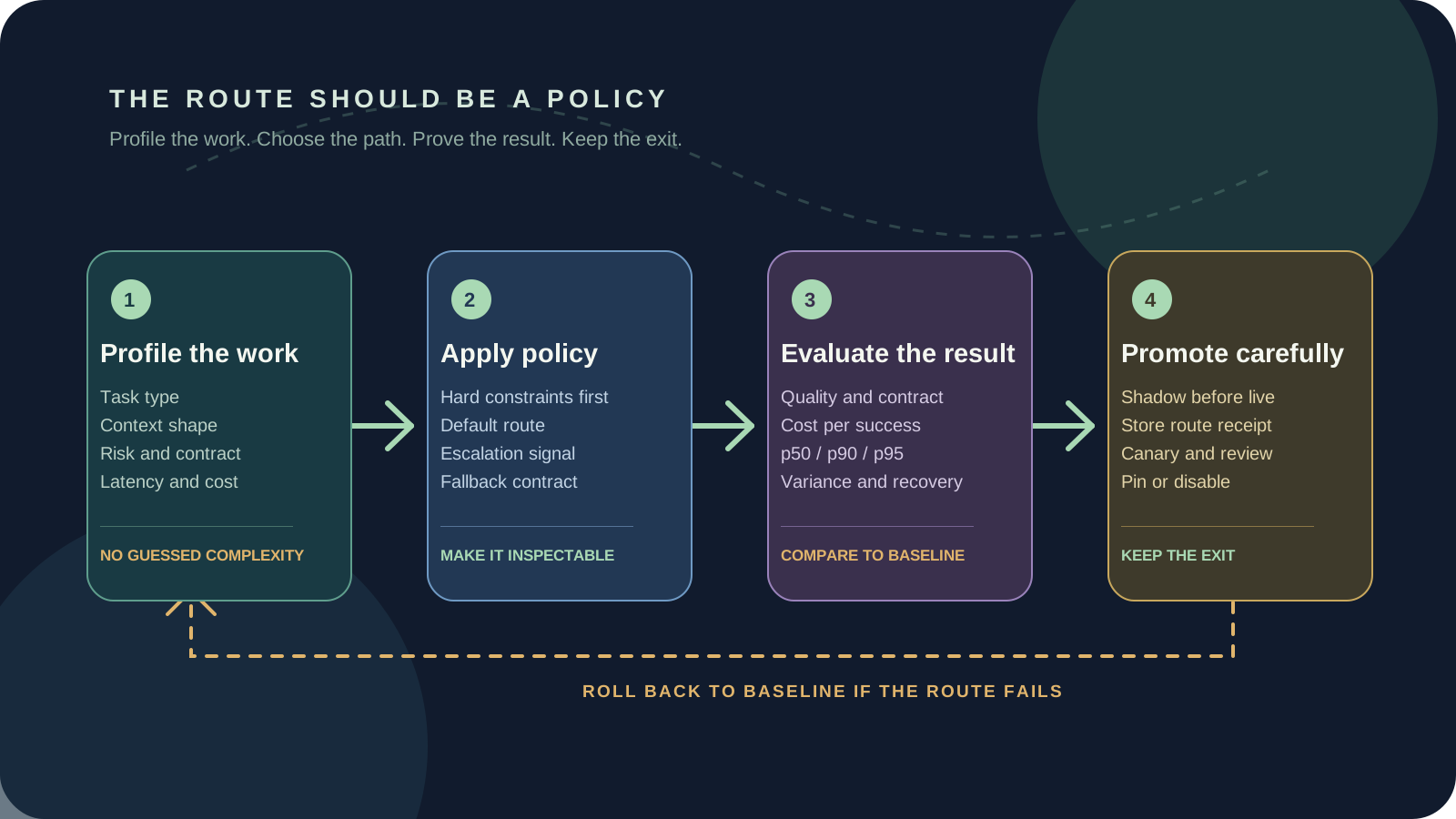
The most expensive model is not always the most expensive decision. Sometimes a smaller model handles the job perfectly. Sometimes it quietly creates retries, corrections, support tickets, or a human review queue that costs more than the original inference. And sometimes the smartest move is to keep one well-understood model instead of adding a router at all.
That is why model routing deserves a little more skepticism than the usual architecture diagram gives it. A router can choose among models, providers, effort settings, or service tiers for each request. It can be a useful production control. It can also become another opaque decision-maker that changes behavior, breaks caching, and makes a bad answer harder to explain.
The business question is not, Can we send easy prompts to a cheaper model? It is: Do we have a stable difference in workload requirements that is large enough to justify a second path, and can we prove that the path still clears our quality floor?
My short recommendation: start with one task-appropriate baseline. Before building a dynamic router, measure output quality, schema or tool correctness, latency percentiles, token cost, retries, and human correction on representative work. Add explicit routing when your traffic has clear segments with different requirements. Test adaptive routing only behind that baseline, with fallback behavior and a route receipt that tells you what happened.
The short answer
Use one model when the workflow is narrow, the quality bar is high, the traffic is still small, or consistency is more valuable than theoretical savings. You can often improve the baseline by shortening outputs, tightening the prompt, reducing unnecessary context, using a lower reasoning effort, caching repeated prefixes, or choosing a smaller model that was designed for the task.
Use explicit routing when you can name the workload segments in ordinary language. For example: classify a support request with a fast model, draft the answer with a mid-tier model, and escalate a policy exception to a stronger reasoning model. The rule can be based on task type, required modality, schema, risk, context length, or whether tools are needed. Explicit rules are not glamorous, but they are easy to inspect.
Test an adaptive router when the requests are mixed enough that fixed rules leave meaningful value on the table, and when you have the data and evaluation discipline to measure it. The router should compete with your current baseline on the whole result, not just on the percentage of calls it sends to a cheaper model.
Postpone routing when you do not know what “good” looks like, when the task changes every week, when most calls are already cheap, or when a route change would create a new safety or approval problem. A router cannot compensate for an undefined product contract.
There is no universal threshold for the right choice. There is a useful sequence:
- Define the task and the failure that matters.
- Pick a baseline that can meet the quality floor.
- Measure the actual workload, including retries and human correction.
- Try lower-cost optimizations that do not change the model path.
- Introduce a second path only when the workload split is real.
- Keep a fallback, a route receipt, and a simple rollback.
What model routing actually means
Model routing is a runtime choice about which inference path handles a request. The path could be a different model, a different reasoning effort, a different provider, a different region, a batch or priority service tier, or a fallback after a timeout. In casual conversation, people often use router to mean only a classifier that sends simple prompts to a small model. Production systems are broader than that.
Imagine a customer-support copilot. One request asks for a three-field classification. Another asks for a grounded response from a policy library. A third asks for an explanation of a contract exception and suggests a next step for a human reviewer. They may arrive through the same text box, but they do not have the same job, context, or consequence.
A routing policy could make these choices:
- Task route: extraction and classification go to a fast structured-output path; open-ended reasoning gets another path.
- Risk route: a low-impact draft can use an inexpensive model; anything that proposes a permission, pricing, or destructive change requires a stronger model and a human gate.
- Context route: short requests use a normal endpoint; long documents use a model or retrieval path that can handle the context.
- Latency route: interactive requests use a responsive service tier; overnight enrichment uses batch or flexible capacity.
- Reliability route: a provider or model failure moves to a pre-tested fallback with the same output contract.
- Quality route: a verification failure escalates the request instead of returning a weak result.
That last category is important. A router that decides only from the first prompt is making a decision before the full work is known. In an agentic AI workflow, tool calls, retrieved documents, intermediate errors, and user follow-up can change the actual difficulty. Routing can happen at the start, between steps, or after a check. Each location has a different cost and failure mode.
The useful mental model is not “a traffic cop chooses the cheapest lane.” It is “a policy selects an inference path under constraints.” Once you use that model, you naturally ask better questions: What information is available at the decision point? Which constraints are hard? What happens when the policy is uncertain? Can someone reconstruct the route later?
Why the choice is changing in 2026
Provider catalogs are no longer a single ladder from “small” to “large.” Official documentation increasingly describes model families and settings by workload. OpenAI's current model catalog presents separate choices for complex reasoning, balancing intelligence and cost, and cost-sensitive high-volume work. Anthropic's model overview similarly describes different models in terms of complex agentic work, speed and intelligence, and fast responses. Google documents model thinking controls and service tiers that change the speed, reliability, and cost profile of the same broad API surface.
Those descriptions are vendor guidance, not an independent leaderboard. The durable observation is narrower: teams now have more levers than a single model ID. The decision may be about model, effort, output length, caching, batch mode, priority, provider, or a combination.
Microsoft's June 2026 production guide puts the shift plainly: the hard part is knowing how to choose, validate, optimize, and operate the model across the application lifecycle. Its table favors smaller models for classification, routing, extraction, and high-volume chat; stronger models for complex reasoning, coding, and planning; and model routers for mixed workloads. It also says public benchmarks are not enough because the model has to work on the application's own prompts, data, users, and business rules.
AWS now documents intelligent prompt routing that predicts response quality across selected models, forwards the request to the path with the best quality-and-cost tradeoff, includes the chosen model in the response, and recommends regular review of performance and cost metrics. That is a real capability, but it is not a reason to skip evaluation. The same AWS documentation says configured routers should be tried and evaluated for the specific application.
At the research edge, the story is less settled. A March 2026 preprint on small language models for front-door routing frames the problem as joint optimization across quality, cost, latency, and governance. Its experiments report that the cost and latency prerequisites can be met while an accuracy gap and the untested link between routing accuracy and downstream output quality remain. That is a useful warning: a classifier can be right about the label and still send the request down the wrong application path.
My synthesis: routing is becoming easier to buy, but not automatically easier to trust. The more choices platforms expose, the more valuable a small, explicit operating policy becomes.
One model, explicit routing, or adaptive router?
These are not three levels of engineering maturity. They are three different fits for different kinds of work.
| Approach | Good fit | Strength | Hidden cost | First proof |
|---|---|---|---|---|
| One baseline model | Narrow task, high consistency, early product | Simple behavior and easy debugging | You may pay for capability every time | Task-level quality, latency, cost, and correction rate |
| Explicit rules | Stable task types or risk tiers | Inspectable and easy to govern | Rules need maintenance as the product changes | Each route clears its own contract on a held-out set |
| Adaptive router | Mixed traffic with enough history to learn from | Can respond to variation without a long rule list | Classification errors, drift, added latency, and opacity | Shadow comparison against the baseline and route-level receipts |
| Provider gateway or fallback layer | Availability, quotas, portability, or vendor operations | Separates app code from provider changes | Different providers may change behavior or schemas | Contract tests, failover tests, and provider-specific quality checks |
The fourth row is worth separating from adaptive quality routing. A gateway that keeps the same model but fails over when a provider is unavailable is solving reliability and portability. It may be valuable even if it never chooses a cheaper model. Calling every gateway a “smart router” hides the business reason you are adding it.
For most new B2B features, I would start with the first row and write down the second row. That gives you a baseline and a future policy without prematurely building an inference committee.
The five dimensions that decide
Model selection conversations often begin with quality and price because both are easy to display on a comparison page. Production decisions need at least five dimensions, and sometimes a sixth: recovery.
1. Quality is a floor, not a trophy
Do not ask which model has the highest average score in the abstract. Ask what failure is unacceptable for this task. A support classifier may need stable labels. A document extractor may need field-level accuracy and strict JSON. A drafting assistant may need groundedness and tone. A planning agent may need tool selection, correct stopping, and a human approval boundary.
Set a minimum acceptable result for each route. A cheaper model that clears the floor is a better choice than an expensive model that adds no useful quality. A cheaper model that falls below the floor is not a saving; it is a new product defect.
2. Latency is a distribution
Averages are friendly to demos. Users experience p50, p90, p95, and time to the first useful token. A router can improve average cost while making a subset of requests slower because it adds a classification call, sends a long context to the wrong path, or creates a retry chain.
OpenAI's latency guidance says smaller models usually run faster and cheaper and that output generation is often the highest-latency part of an LLM request. That supports a simple first experiment: shorten the output contract and test a smaller task-specific model before adding a dynamic decision step. Microsoft’s router evaluation guidance specifically recommends comparing latency percentiles rather than only averages.
3. Cost includes the work around the call
Token price is only one line in the cost ledger. Include router calls, classifier calls, input and output tokens, cache hits and misses, tool calls, retries, failed structured outputs, human review, and the cost of a slower experience. An answer that is 30 percent cheaper per successful call may not be cheaper if it fails often enough to trigger a second model.
Here is an intentionally illustrative example, not a benchmark. Suppose a baseline model costs five units per request. A router sends 70 percent of requests to a one-unit model and 30 percent to the five-unit model. The weighted inference cost is 2.2 units per request before router overhead, retries, cache effects, and correction time. If the cheap path produces enough failures to create an additional 1.3 units of downstream work, the apparent saving nearly disappears. The arithmetic is easy; the measurement is the product work.
4. Reliability is more than uptime
A model can be available and still be unreliable for your contract. Track malformed JSON, missing citations, wrong tool arguments, refusal behavior, incomplete answers, timeouts, and unexpected style changes. A route that uses a model with a different structured-output implementation may pass a general quality check and fail your application parser.
Keep a fallback that speaks the same output contract. Do not treat “try another model” as a recovery plan until you know what happens to the original context, tool state, idempotency key, user approval, and partial work. A fallback should not repeat a side effect that already happened.
5. Control and explainability are product features
If a user asks why a response changed, “the router decided so” is not a useful explanation. Record enough to reconstruct the material path: policy version, route reason or task label, model family and version, effort or service tier, fallback status, prompt or template version, evaluation flags, and timestamps. Redact sensitive content and never record hidden reasoning just to make an audit log look impressive.
A May 2026 research paper calls this a route receipt: a compact record of the runtime conditions that shaped an answer. The term is not a universal standard, but the underlying idea is practical. If route-level behavior matters, make the route visible to operators.
6. Recovery should be designed before promotion
Ask how you turn routing off. Can you pin all traffic to the baseline? Can you replay a failed request? Can you compare a new route against the prior output? Can you change a rule without losing the old route record? Can a human approve the proposed action after the model path is known?
This matters most in agentic AI workflows. A router that changes the planner can change which tools it calls. Keep routing decisions separate from authorization. The model path may suggest what to do; application policy still decides whether the action is allowed. The broader guide to agent security and authorization covers why a prompt or model choice cannot become a permission layer.
Start with the baseline you are tempted to skip
A baseline is not “whatever model the prototype happened to use.” It is a reproducible configuration that represents the current product: model version or alias, prompt and tool definitions, context construction, output schema, effort setting, service tier, retries, timeout, and post-processing.
Freeze that configuration long enough to answer four questions:
- What percentage of representative tasks meets the quality contract?
- What are p50, p90, and p95 response times?
- What is the end-to-end cost per successful task after retries and human correction?
- Which task types or failure modes are responsible for the pain?
Without a baseline, a router demo can look successful for a misleading reason: it may be compared with a vague memory of the old system, a public benchmark, or the most expensive path instead of the actual product path. A baseline gives you something to beat and something to return to.
Make the dataset boring. Include real task shapes with sensitive information removed or replaced, recent examples, edge cases, long contexts, empty inputs, conflicting instructions, and cases that caused support or review work. Include the current production output as a candidate when you compare models. This prevents the newest model from getting a free pass simply because it is new.
For quality judging, use deterministic checks wherever possible: schema validation, required fields, citation presence, allowed tool names, numeric constraints, and state-transition rules. Use a human or separate judge for dimensions that cannot be checked with code, and keep the criteria explicit. A single “looks good” score hides the failure you need to find.
Find the real traffic segments
Do not begin by labeling prompts easy, medium, or hard. Begin by labeling the job the product is doing. “Summarize this” could mean summarizing a short internal note, a 600-page contract, or a set of conflicting customer records. Prompt length is a clue, not a policy.
Useful segment fields include:
- Task type: classify, extract, summarize, draft, retrieve, plan, or execute.
- Output contract: free text, JSON schema, citations, code, tool calls, or a structured decision brief.
- Context shape: short text, long document, image, audio, retrieved records, or multiple sources.
- Risk: reversible draft, customer-visible message, financial or access-changing proposal, or destructive action.
- Latency need: live interaction, normal request, or offline batch.
- Verification: deterministic parser, retrieval check, human review, or no practical check.
A simple segment can be more stable than a guessed complexity score. “Strict JSON extraction from an invoice” tells you more about model fit than “prompt has 900 tokens.” “Draft a response that quotes the current policy” tells you that grounding and citation behavior matter. “Plan a multi-step repository change” tells you that tool use and recovery matter.
Now look for a segment where the requirements are genuinely different. If every segment needs the same model, same output contract, same latency, and same review, routing is probably needless. If one segment is high-volume, low-risk, and easy to verify while another is rare, complex, and expensive to get wrong, routing has a reason to exist.
Why prompt-only routing breaks
Prompt-only routing is attractive because the input is already available. A small classifier reads the request and selects a model. For a clean single-turn task, this can be enough. For a tool-using or agentic workflow, the initial text may be a poor proxy for the eventual work.
Manifest's July 2026 account makes this argument from operating experience. The company says its router classified requests into four complexity tiers, then found that complexity often became visible only through later tool calls and web searches. Its example is a repository task whose difficulty depends on the repository, not only the sentence describing it. The same account says cache behavior, consistency, and maintenance overhead can make a single battle-tested model more attractive.
The lesson is not “prompt classifiers never work.” The lesson is to route where the information needed for the decision is available. Use task metadata or explicit product state where possible. Route again after retrieval or verification when that changes the path. And if the route depends on information the classifier cannot see, admit that uncertainty and use a safe baseline.
A robust first policy often looks like this:
- Apply hard constraints: modality, context limit, required schema, region, provider availability, and risk tier.
- Choose a default path for the task type.
- Escalate on a known signal: missing fields, low retrieval support, tool failure, conflicting records, or a human request for deeper analysis.
- Record the route and continue only if the output contract remains valid.
That is less like a clever AI router and more like ordinary software engineering. That is a feature.
Optimize the path before you add a router
Routing is one lever among many. Try the lower-risk levers first, especially if you are still learning the workload.
Shorten the answer
If users need a label and two reasons, do not ask for an essay. A shorter output can reduce latency and cost and make evaluation easier. Keep the explanation available in an inspectable trace or expandable view if the product needs it.
Remove context that does not change the decision
More context can make a model appear more informed while increasing cost, latency, and opportunities for contradiction. Use retrieval filters, summaries with provenance, or structured fields when they preserve the needed information.
Use caching for repeated work
Google's current optimization documentation treats caching as a distinct cost and latency tool for repeated context. Manifest's operator account makes a similar point: cache behavior can matter more than changing models. If a large system prompt or reference document is repeated on every call, routing to another model may throw away the cache advantage.
Use batch or flexible capacity for work that is not interactive
Not every request needs a live response. Google documents batch and flexible service tiers for different throughput, reliability, and latency needs. Moving overnight enrichment out of the interactive path may deliver more value than adding a classifier to every request.
Adjust reasoning effort inside the baseline
OpenAI and Google both document controls for reasoning effort or thinking budget, with model-dependent settings that trade speed and token use against deeper reasoning. This can be a clean first experiment when the model is capable but overthinking simple requests. Measure it like any other change; a lower setting is not automatically better.
If these changes solve the problem, you have learned something valuable and avoided adding a new runtime decision. If they do not, you now have a cleaner baseline for a routing experiment.
How to evaluate a router without fooling yourself
Evaluate a router against the current baseline, not against an imaginary always-expensive system. Run both paths on the same representative inputs when you can. If the router is adaptive, capture which model it selected, why it selected it, and whether the answer passed the application checks.
Microsoft's model-router guidance recommends comparing quality, cost, and latency before production traffic. It describes pairwise quality comparisons with response order swapped, actual workload prompts, token-aware cost accounting, and p50/p90/p95 latency. It says fewer than 30 prompts is directional and recommends at least 100 for statistically reliable results in its methodology. Treat that as a useful vendor method, not a universal law: a high-risk workflow may need more coverage, and a narrow deterministic task may need less to find a clear failure.
Your evaluation sheet should include:
| Dimension | Question | Evidence to collect | Promotion rule |
|---|---|---|---|
| Outcome quality | Did the task produce the right result? | Reference answer, human rubric, or deterministic check | Meets the task floor; no critical failure |
| Contract quality | Can the application consume it? | Schema validity, required fields, citation and tool checks | No unacceptable contract regression |
| Latency | How long do users wait? | p50, p90, p95, time to first useful output | Stays inside the experience budget |
| Economics | What does a successful task cost? | Tokens, router overhead, retries, cache, review time | Improvement remains after downstream work |
| Reliability | What happens during failure? | Timeouts, quotas, fallback rate, partial work, provider errors | Fallback is tested and reversible |
| Variance | Are bad outcomes concentrated in a tail? | Failure distribution by task type and route | No hidden high-impact tail |
| Explainability | Can we reconstruct why this path ran? | Route receipt, policy version, model, effort, timestamp | Operators can inspect and roll back |
Do not let the router win by moving failures out of view. If a cheap path returns an answer that looks acceptable but needs a human to repair every time, count that human work. If a route sends a hard request to a stronger model after a cheap failure, count both calls. If a route reduces average latency but worsens p95 for customers asking long questions, show the segment breakdown.
Also test route stability. Re-run the same input with the same policy and confirm that the route is not changing randomly unless randomness is an intentional part of the design. If models or provider aliases change underneath you, keep the route receipt and repeat a canary evaluation before expanding traffic.
Route receipts and governance
A route receipt is not a user-facing explanation of hidden model reasoning. It is an operator record of the material runtime path. For a normal low-risk answer, it might be a compact object like:
{
  "policy": "support-draft-v3",
  "task": "policy-grounded-draft",
  "route": "standard-model",
  "effort": "medium",
  "fallback": false,
  "cache": "hit",
  "contract": "support-reply-v2",
  "timestamp": "2026-08-19T14:32:00Z"
}
The values above are illustrative. The useful fields for your system will differ. Do not log secrets, full sensitive prompts, or raw customer documents just because you want a detailed audit. Store an identifier and a redacted summary when that is enough to reconstruct the route.
For tool-using agents, include the route receipt in the run trace next to tool calls, approvals, and final effects. A model route should never silently change authorization. If a stronger model is allowed to draft a purchase request, that does not mean it is allowed to submit the purchase. If a fallback model takes over after a timeout, the application still needs to know whether any earlier tool call completed.
Use policy versioning. If you change the threshold, task map, model alias, or fallback, create a new policy version. That lets you answer “what changed?” without pretending the model alone caused the outcome.
When a router is the wrong buy
Routing tools are appealing because they promise to make model choice somebody else's problem. That can be helpful when the tool exposes the controls your application needs. It can be a poor fit when it hides the route, adds a markup you cannot explain, changes providers without contract tests, or makes it difficult to pin a model during an incident.
Ask a managed router vendor these questions:
- Can I see the selected model, policy reason, fallback, and route timestamp for every request?
- Can I pin a route or disable adaptive selection during an incident?
- Can I provide my own evaluation set and see results by task category?
- How are tool calls, structured outputs, refusals, and retries handled across models?
- Is the router markup included in cost reporting, and can I export the raw token counts?
- How are prompt caching, regional routing, data retention, and provider-specific policies handled?
- Can the fallback preserve idempotency and the application's approval state?
Build a small router when your rules are simple and your team needs full control. Buy a router when the operational surface saves time and still exposes the evidence and controls you need. Postpone either option when the traffic is not yet stable enough to tell whether the extra layer is helping.
A practical 30-day routing pilot
A routing pilot should be designed to produce a decision, not to prove that routing is exciting.
Week one: define the contract
Choose one workflow. Write the input, output, allowed tools, quality floor, latency budget, cost budget, failure response, and human escalation condition. Define what counts as a critical failure. If the workflow can change money, access, public content, or customer state, keep the action behind an application-level approval.
Collect a representative set of examples. Remove sensitive data safely, preserve the shapes that make the task difficult, and include the current production output as a baseline candidate. Record how the current system behaves before changing it.
Week two: improve the baseline
Test prompt and context changes, output limits, caching, reasoning effort, service tier, and a smaller task-appropriate model. Do not yet add an adaptive router unless the baseline experiment itself requires it. The goal is to learn how much of the problem is model choice and how much is unnecessary work around the model.
Week three: add one explicit alternative
Choose one route split that a person can explain. Use a rule based on task type, structured-output need, context shape, or risk. Keep a default baseline and a tested fallback. Run the route in shadow mode where possible: make the alternative prediction or response, but keep the current path responsible for the user-visible result.
Capture quality, contract validity, cost, latency, retries, and route receipts. Review failures by category. If the alternative wins only on an average score while producing a more dangerous tail, it has not won.
Week four: decide whether the complexity earned promotion
Promote a route only if it clears the quality floor, stays inside the experience budget, has a favorable end-to-end cost, and can be disabled quickly. Start with a small, reversible percentage of traffic or a low-risk task type. Keep the baseline available. Schedule a review after enough new production examples arrive, because the workload can change after users adapt to the feature.
Stop the pilot if the route is hard to explain, the savings depend on unsupported assumptions, the fallback creates duplicate effects, or the task is too variable for the available signals. “Not yet” is a useful result. It tells you what measurement or product definition is missing.
Buy, build, or postpone?
Here is the decision I would use for a small B2B team:
- Keep one model if you are still discovering the workflow, the quality bar is strict, or consistency and debugging speed matter most.
- Build explicit rules if you have two or three stable task types and can write the policy without a model judging its own difficulty.
- Buy or test adaptive routing if traffic is genuinely mixed, you have enough labeled or reviewable examples, and the managed tool exposes route evidence, fallbacks, and evaluation controls.
- Use a gateway or failover layer if the real need is provider availability, quotas, regional behavior, or portability—not quality optimization.
- Postpone if the expected gain is based on a public leaderboard, a vendor savings claim, or the feeling that every AI product should have a router.
One practical pattern is to keep the application interface model-agnostic without making runtime selection opaque. Define an internal task contract, map it to a pinned model configuration, and allow a controlled policy to change the mapping. That gives you portability without turning every request into a mystery.
If you are trying to make this real, BishopTech can help review the workflow, define the first evaluation set, and scope a reversible implementation through custom software work or an automation and growth system. The useful starting material is not a list of favorite models. It is a handful of real tasks and the cost of getting them wrong.
What I would predict next
Prediction: the durable abstraction will be a task policy, not a universal router. Teams will specify “support classification,” “policy-grounded draft,” or “repository change proposal” and attach a tested configuration to each. The configuration may change from one model generation to another, but the contract, evaluator, route receipt, and rollback behavior will be the durable assets.
Prediction: route decisions will move later in the workflow. Early routing will handle obvious constraints such as modality, context length, and latency tier. Later decisions will use retrieved evidence, tool results, verification failures, or a human's request for deeper analysis. This will make routing less like a single front door and more like a set of checkpoints.
Prediction: caching and output control will steal some of the attention from model routers. Teams will discover that a stable prompt, shorter response, and repeated-context cache can improve the economics without changing behavior. That is less fun to announce, but easier to explain to a customer.
Prediction: route receipts will become normal operational data for adaptive AI products. The exact format may vary, but teams will need to know which model, effort, provider, service tier, fallback, and policy version produced a result when a customer asks about a changed answer.
Those are inferences from the current direction, not settled facts. The practical decision today remains small: establish the baseline, name the segment, and test the smallest routing change that can teach you something.
FAQ
Does every AI application need a model router?
No. A single well-understood model is often the best starting point for a narrow task, especially when consistency, debugging, and a strict output contract matter more than marginal inference savings. Add routing when the workload has stable segments with different requirements and you can measure the tradeoff.
Will routing automatically reduce my AI bill?
No. It can reduce model spend on some traffic, but the total result also includes routing overhead, retries, cache behavior, tool calls, human correction, and slower or less reliable experiences. Compare successful end-to-end tasks with the current baseline.
Should I route based only on prompt complexity?
Usually not. Prompt text can be useful, but the actual difficulty may appear after retrieval, tool calls, or inspection of a document or repository. Prefer task metadata and hard constraints where possible, and test whether the route decision predicts the final outcome rather than only a label.
How many examples do I need to test a router?
There is no universal number. Microsoft’s model-router methodology says fewer than 30 prompts gives directional signal and recommends at least 100 for statistically reliable results in that method. Treat those as guidance, then adjust for task variance, consequence, and the quality of your evaluator. A high-impact workflow needs enough cases to exercise its failures, not just enough to produce a nice average.
Is a managed router better than building one?
It depends on the job. A managed router can reduce infrastructure work, while a small rule table can be easier to inspect and govern. Choose the option that exposes route evidence, fallbacks, evaluation controls, cost data, and a kill switch. If it hides those details, the convenience may create operational debt.
What should I log when a router chooses a model?
Log a redacted route receipt: policy version, task category, selected model or service tier, effort setting, fallback status, cache status when relevant, contract version, timestamps, and outcome checks. Keep secrets and sensitive content out of the receipt. For agentic workflows, connect the receipt to tool calls, approvals, and final effects.
Sources and further reading
The links below are the public references used for the technical and operational claims in this guide. Provider documentation and model behavior can change, so re-check the live page before making a production choice.
- Microsoft Foundry: A developer's guide to managing models, cost, and quality
- Microsoft Azure AI: Model Router evaluation guidance
- AWS Bedrock: Intelligent prompt routing
- OpenAI: Models
- Anthropic: Claude model overview
- OpenAI: Latency optimization
- OpenAI: Reasoning models and effort
- Google AI: Gemini API optimization and inference
- Google AI: Gemini thinking controls
- LMSYS: RouteLLM
- Johnson and Lee: Evaluating Small Language Models for Front-Door Routing
- Schmalbach: Model Routing as a Trust Problem
- Manifest: Everyone is building LLM routers, we deprecated ours
- Practitioner discussion: how well do AI routers handle model selection?
- Practitioner discussion: how do you decide which LLM API to use?
- Practitioner benchmark discussion: how do you pick a model for a repeated production call?
If you want more context on the larger system, read the rest of My Mind, especially the guide to what agentic AI can actually do and the guide to where persistent agent memory belongs. If you have a real workload and need to decide whether one model, explicit routing, or a small pilot makes sense, share the example with BishopTech and start with the decision before the infrastructure.