
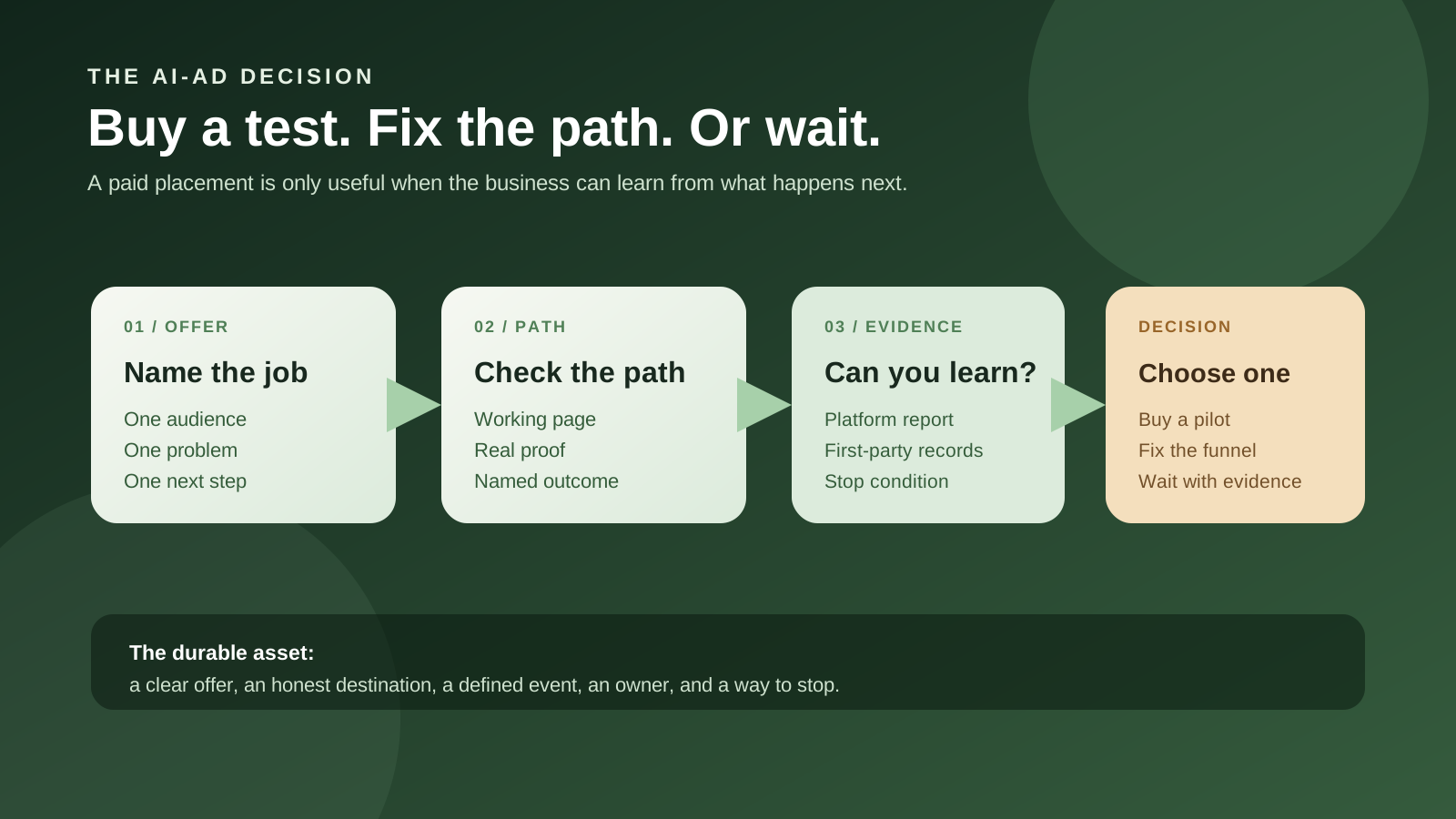
The short version is this: do not buy an AI ad because the word “AI” makes the channel sound inevitable. Buy a small pilot only when you have a clear offer, a working destination, a real baseline, and a way to compare the platform’s report with your own business records. If any of those are missing, fix the funnel first. If the audience is not on the surface, or the result cannot be measured without hand-waving, wait.
That may sound cautious at exactly the wrong moment. OpenAI is testing a visual ad format beside images generated in ChatGPT. Google is expanding ad formats inside AI Mode, including offers and a business agent for leads. People are using chatbots to compare products, services, and tradeoffs before they ever open a traditional search result. The ad industry is moving quickly.
But a new place to buy attention is not automatically a new place to buy customers. The useful question for a founder or operator is not “How do I get in first?” It is “What job would this channel do for my business, and what evidence would tell me to keep, change, or stop the test?”
The three-path answer: buy, fix, or wait
There are three honest answers to the question “Should we try AI ads?”
| Path | Choose it when | What you are trying to learn | Do not confuse it with |
|---|---|---|---|
| Buy a pilot | You have one clear offer, a plausible audience fit, a working destination, and a measurement owner. | Whether this surface can create a useful action at an acceptable cost or teach you something worth the spend. | Proof that the platform will scale or beat every other channel. |
| Fix the funnel | The offer, page, response time, tracking, or proof is weak even before an ad arrives. | Whether the business can convert and serve the attention it already earns. | “AI visibility” work that never reaches a customer or a completed job. |
| Wait | The platform cannot reach your buyer, the placement is not eligible, or you cannot define a trustworthy outcome. | Whether a future change in access, inventory, or measurement makes a test meaningful. | Doing nothing. You can still collect customer-source signals and improve the owned path. |
The middle option is the one most businesses skip. Owners see a new ad format and either rush to spend or dismiss it as a gimmick. A funnel fix is less exciting, but it often has the highest option value. A fast page, clear offer, useful proof, working form, and quick follow-up help regardless of where the next visitor came from.
What actually changed in October 2026
On October 5, OpenAI announced a visual ad format for ChatGPT. The company says the initial test will run during image generation for users on the Free and Go plans in the United States, with an initial group of advertisers. The ad is meant to sit alongside the generated image, be clearly labeled, and remain separate from the image itself. OpenAI describes the use case as product inspiration, product usage, or the experience a product makes possible.
That is a different creative moment from a text ad under a written answer. Someone asking for a living-room mood board is already imagining a room. Someone asking for a wedding-flower concept is already imagining a ceremony. A visual placement can meet that person while the picture is being formed.
It also has a narrow boundary. OpenAI says this particular format is an initial test, not a universal placement for every user and every conversation. The current ChatGPT help documentation says ads may appear for Free and Go users, while Plus, Pro, Business, Enterprise, and Edu accounts do not have ads. The same documentation says ads are separate from answers and that advertisers do not get users’ chats, memories, names, email addresses, or precise locations.
Google is building a related but not identical path. In its May 20 Google Marketing Live announcement, Google described conversational and AI-powered ad formats in Search, an AI Mode business agent for leads, and an expanded Direct Offers pilot. Direct Offers can surface promotions as shoppers explore options in AI Mode, with native checkout support for Universal Commerce Protocol merchants described as part of the expansion.
So the change is not one new “AI ads” product. It is a change in where a paid message can appear:
- Visual inspiration: beside a generated visual, while a person is exploring what a product or service could look like.
- Comparison: inside an answer or comparison experience, while a person is narrowing choices.
- Promotion: inside an offer or lead conversation, when the person is close enough to act.
Those moments are not interchangeable. A florist may benefit from visual inspiration. A printer retailer may benefit from comparison intent. A complex B2B implementation firm may need a longer conversation, a case study, and a human qualification step. The ad format should follow the job, not the other way around.
A paid placement is not an organic recommendation
This distinction matters because AI interfaces blur several experiences together. A person may see a model answer, an organic product mention, a merchant result, a sponsored placement, and a link to a business in one conversational flow. They may reasonably assume the system has independently chosen the business. That is not what a paid placement means.
OpenAI’s current help documentation says ads do not influence the answers ChatGPT gives. It says ads are run on separate systems, are clearly labeled, and do not mean OpenAI endorses or recommends the advertiser. That is the platform’s stated design. Your own creative and landing page still need to make the commercial relationship understandable.
The Federal Trade Commission’s guidance on native advertising makes the same reader-protection point in broader terms. The closer an ad looks like the surrounding content, the more important clear and prominent disclosure becomes. A label has to make sense to an ordinary person. Technical language that only an ad buyer understands does not do the job.
There is a second reason to keep paid and organic separate: the system’s product judgment may not be stable. A September 2026 research paper audited 1,536 product-query responses from ChatGPT, Gemini, and Google Search using a dataset of 2,528 commercial-advice queries. The authors reported that ChatGPT expressed a first-person product preference in 79% of product-recommending responses in their sample, compared with lower rates for the other systems, and that recommendations often changed across repeated requests.
That study does not tell you how an ad will convert. It does tell you not to sell an ad as a magic stamp of product truth. A paid placement buys a chance to be seen in a context. It does not guarantee that the surrounding answer is accurate, stable, favorable, or sufficient for a purchase.
Organic discovery: “The system chose to mention or retrieve this business through its own ranking, retrieval, or recommendation process.”
Customer proof: “A real person can verify the claim, compare the offer, and decide whether it fits.”
You may work on all three. You should not promise one when you only bought another.
What the early evidence says, and what it does not
OpenAI’s announcement includes encouraging partner-reported results. It says WeightWatchers saw an attributed cost per acquisition 15.3% below a blended paid-search benchmark, WorkMagic reported that 67% of incremental purchases for Dose came from net-new customers, and Triple Whale reported that 93% of Portland Leather’s ChatGPT-ad visitors were new.
Those numbers are useful as reasons to investigate. They are not a forecast for your business. They were selected by the platform and its partners. The announcement does not give you a public, independent average across advertisers, verticals, budgets, creative quality, landing pages, or attribution setups. Read them as case studies from an early program, not as a benchmark you can put in a spreadsheet before your own test.
An independent August 2026 study provides a different kind of evidence. The authors collected more than 3,000 ChatGPT ads from 186 advertisers across 335 prompts using a sock-puppet audit. They found that early ads skewed toward consumer goods, directed people to a specific advertiser rather than a particular product, and were separated from the model response text. The paper is an early snapshot, and the authors explicitly anticipate that the interface will change.
That early snapshot is important for a small business because it pushes against two bad assumptions. First, this is not yet a mature, universal replacement for search and social. Second, you do not have to understand the whole future of advertising to run a bounded learning test. You do need to accept that the platform can change while you are learning.
Public practitioner discussions add another warning. In an r/OpenAI thread, a small e-commerce advertiser described a campaign that showed a sudden jump in reported impressions and clicks while the advertiser’s own analytics did not show a matching visit pattern. The post also described unexpected charges. That account is anecdotal and unverified. It is not proof that the platform always misreports. It is proof that advertisers are already asking how to reconcile platform reports, site analytics, and billing.
In an r/PPC thread, practitioners discussed whether a comparison-heavy printer retailer might be a good fit for ChatGPT ads, while describing the platform as new and difficult to judge. In another small-business discussion, an owner reported that a checkout “how did you hear about us?” question produced a few customer mentions of ChatGPT even while Meta ads and email still drove most of the business.
These discussions are not market research. They are user signals. They show the questions that appear when a channel is new: Does the audience exist? Do the clicks look real? Are people discovering us organically or through a paid placement? Is this a better use of budget than the channel we already understand?
Check fit before you choose a budget
The first question is not “How much should we spend?” It is “What kind of moment are we trying to enter?” Write the answer in one sentence before opening an Ads Manager.
- Visual inspiration: “I help a person picture the result before they know the exact product or provider.”
- Comparison: “I help a person choose between options with a clear tradeoff, use case, or price boundary.”
- Promotion: “I have a timely offer with eligibility, inventory, capacity, and an easy next step.”
- Lead conversation: “I can answer the first questions accurately and route a qualified person to a human or a defined workflow.”
Visual placements are a more natural fit for furniture, home projects, fashion, travel, food, events, local experiences, and products whose value is easy to picture. Comparison placements can fit products with clear specifications, service tiers, or problem-to-solution language. Complex B2B services can still test AI-native ads, but the ad is usually only the first step. If the buyer needs a technical review, security answers, procurement documents, or a custom proposal, do not judge the channel by an immediate checkout that was never realistic.
A B2B implementation firm might test an ad offering a narrow “AI workflow boundary review” instead of advertising “AI transformation.” A local remodeler might offer a room-planning consultation with a gallery of completed work. A SaaS company might test one use case with a short demo, not a homepage that asks the visitor to understand the entire platform.
There is no prize for making the audience as broad as possible. Broad targeting makes a new channel harder to interpret. Choose the smallest customer problem that is worth solving and easy to recognize.
The readiness test: green, yellow, or red
Use this table before spending. It is not a grading system. It is a way to expose the part of the business that the ad would make visible.
| Readiness area | Green enough to test | Yellow, fix alongside the test | Red, fix before buying |
|---|---|---|---|
| Offer | One audience, one problem, one concrete next step. | The offer is useful but has several versions or unclear qualification. | The team cannot say what the ad is asking the person to do. |
| Creative | The image, title, and page describe the same real thing. | Proof or product context is thin, but the claim can be tightened. | The creative relies on hype, imitation, or a claim the business cannot prove. |
| Destination | The page loads, works on a phone, answers the first question, and has a working action. | The page works but the form, booking flow, or follow-up needs cleanup. | There is no owned page, the contact path is broken, or nobody owns the response. |
| Measurement | A named event can be checked in your own system and against the ad platform. | You have platform and site data but have not reconciled the definitions. | The only success measure is impressions, clicks, or a dashboard total you cannot verify. |
| Capacity | Someone can respond, fulfill, schedule, or qualify the resulting demand. | Capacity is limited but can be stated in the offer and monitored. | A successful result would create work the business cannot serve. |
| Stop rule | The owner knows the spend cap, review date, and reason to stop or change. | The team agrees on the goal but has not written the review conditions. | Nobody can stop the campaign or explain what a bad result looks like. |
A green row does not mean the test will work. It means the test can teach you something. A red row means the ad would mostly measure the weakness of the system behind it.
Measurement is not a reporting detail
Measurement is the part that makes an AI-ad pilot a business experiment instead of a mood. It is also the part that is easiest to postpone because it feels less creative than choosing an image.
OpenAI’s current conversion documentation says advertisers can send events through its Pixel, Conversions API, or both. A conversion can be reported when an event matches the configured campaign event, occurs inside the attribution window, and can be connected to an eligible click using available measurement signals. The documentation also describes click references, first-party cookies, advanced matching, and modeled measurement where available.
That is a real measurement system. It is not the same thing as ground truth. A platform can tell you what it attributed under its rules. Your business still needs to know whether a lead was qualified, whether an order was profitable, whether the person was already known, whether the phone rang, whether the appointment happened, and whether the result was incremental.
Before the pilot, define four layers:
- Platform event: What does the ad system count as a click, lead, purchase, or other conversion?
- Site event: What does your website or app record, and does it preserve the campaign reference through redirects and forms?
- Business event: What counts in the system of record: a qualified lead, paid invoice, booked appointment, activated account, or completed project?
- Incrementality question: What would have happened without this campaign, and what comparison can you actually make?
For a local service, the business event may happen by phone. For a B2B service, it may happen weeks after a form submission. For a product, it may happen online but be refunded later. A dashboard that stops at clicks is not wrong. It is simply answering a smaller question than the owner needs answered.
Use a plain reconciliation sheet if you have to. Record campaign name, creative, landing URL, tagged sessions, form submissions, calls, qualified opportunities, sales, refunds, gross margin where appropriate, and human follow-up time. Do not put secrets or unnecessary personal data in it. The point is not to build a new analytics empire. The point is to keep one platform’s vocabulary from becoming the company’s only memory.
Better pilot question: “Did a clearly defined customer action happen, can we trace it across systems, and did the result justify the cost and attention compared with the path we already use?”
What to fix before buying an AI ad
There are five fixes that make almost any paid channel easier to evaluate.
1. Make the offer specific
“We build custom AI solutions” is a category description, not an offer. “We review one customer-support workflow and return a bounded automation plan with permissions, measurement, and a human handoff” is easier for a person to understand and easier for a platform to match to a context.
Specific does not mean narrow forever. It means narrow enough that you can tell whether the person who clicked had a reason to do so. Name the job, the starting condition, the expected artifact or action, and the boundary. If the ad promises a mood board, show what the person receives. If it promises a lead conversation, define which questions the automated path can answer and when a human takes over.
2. Make the destination do one job
The person arriving from an AI answer may have less context than you think. They may remember a product category but not the exact phrase that caused the ad to appear. The landing page should quickly answer: what is this, who is it for, what does it cost or require, what proof can I check, and what happens next?
Do not send a visual-intent visitor to a generic homepage with twelve navigation choices. Do not send a complex B2B buyer to a form that asks for a phone number without explaining why. Do not let an AI-generated image create an expectation your real inventory, service area, or delivery process cannot meet.
Mobile matters because the person may be exploring in a phone conversation, not sitting at a desk with time to decode a page. Test the form, the phone number, the calendar, the confirmation message, and the handoff from a real device. An ad cannot compensate for a button that does nothing.
3. Add proof without turning it into theater
Use the kind of proof the decision requires: real photos, clear specifications, a process description, customer feedback, an example deliverable, a service area, a response time, or an explanation of what is not included. Do not invent a testimonial because a page feels empty. Do not use a generated image as if it were a photograph of work you completed.
Public discussions about AI discovery often jump straight to “How do I make the model recommend me?” A better first question is “What would a cautious customer need to verify before trusting this business?” The answer improves your owned surface whether or not an AI system sends the next visit.
If you want the deeper technical distinction between paid distribution and citation-ready owned content, the AI search visibility guide is the better companion read. It covers how to make a page clear and useful to answer engines. This article is about deciding when to pay for attention around those experiences.
4. Make follow-up part of the ad
A lead is not a result just because it entered a CRM. Decide who responds, how quickly, with what context, and what happens if the person does not qualify. If a business agent answers the first question inside an ad, the workflow still needs a clean handoff to a person or a defined next step.
That is where an AI agent or workflow deserves a little extra caution. A model may draft a response or collect structured details. It should not quietly decide that a customer is eligible, disclose restricted information, promise a delivery date, or change a record just because the ad produced a conversation. Keep identity, authorization, validation, and escalation outside the model. If the pilot includes tool use, evaluate the complete workflow, not just whether the generated sentence sounds good. The production AI evaluations guide covers that broader evaluation problem.
5. Ask customers directly
A simple “How did you hear about us?” question is not perfect. People forget, choose the closest option, or name the conversation they remember instead of the ad that started it. It is still useful as a second signal, especially when the platform and analytics reports disagree.
Ask at checkout, during intake, or after a qualified conversation. Keep the options short and let the person write “other.” Compare the answers with tagged sessions, call records, and sales outcomes. Do not use a small self-selected sample to claim a market trend. Use it to find questions worth investigating.
When buying a pilot is reasonable
I would consider a small AI-ad pilot when most of these conditions are true:
- The audience uses or plausibly fits the specific surface and plan where the ad can appear.
- The offer is understandable without a long explanation.
- The creative can show a real product, process, result, or use case without misleading the viewer.
- The landing page is fast, mobile-safe, and connected to a real response path.
- The business has a baseline from an existing channel or recent comparable period.
- One person owns the campaign, the destination, the data definitions, and the stop decision.
- The budget is a fixed learning cost the business can lose without putting operations at risk.
- The pilot has one primary outcome and a small set of diagnostic measures.
The last point is easy to miss. A pilot can have several observed numbers without having several goals. Pick one primary outcome. For an online product it might be a completed purchase with a defined margin threshold. For a local service it might be a qualified booking request. For a B2B service it might be a sales-qualified conversation, not a raw form fill.
Use supporting measures to explain the result: landing-page engagement, form completion, call answer rate, qualification rate, sales cycle, refund rate, or human review time. If the primary outcome is weak but the audience signal is strong, you may improve the offer or page. If clicks are strong but the business outcome is absent, the ad may be attracting curiosity rather than fit. If nothing happens, the surface may be too small, the creative may be wrong, or the audience may not be there. The pilot should help you distinguish those possibilities.
When fixing the funnel is the better investment
Fix first when the business has a demand problem that is really an explanation problem. A person cannot choose an offer they do not understand. A model cannot make an unclear service clear just by placing it next to an answer.
Fix first when your page has no proof. Fix first when the phone is not answered. Fix first when a form submission disappears into an inbox. Fix first when the owner cannot tell which events matter. Fix first when a new customer would have to repeat the same information to three people because the handoff is not designed.
Also fix first when your product is visual but your assets are not honest or usable. The visual ad announcement should prompt a better photo library, clearer descriptions, and a more deliberate page. It should not prompt a rush to generate a gallery of scenes that the real business cannot deliver.
For a small business, the fix-first work can be surprisingly concrete:
- Choose the one offer you would be happiest to sell this month.
- Collect the real photos, examples, specifications, and customer questions that explain it.
- Build or repair one page around that offer.
- Add tagged links and one business outcome event.
- Write the response and follow-up process before you buy attention.
- Ask a few real customers what they thought the offer meant before launching.
That sequence may reveal that your first useful test is not an AI ad. It may be a better page, a clearer booking flow, a review request, a call-answering system, or a small content experiment. Those are not detours. They are the infrastructure a paid test would need anyway.
When waiting is the responsible choice
Wait when the platform is not available to the buyer you want. OpenAI says Ads Manager availability changes by country, and the visual-format announcement describes a U.S. test for an initial group of advertisers. A plan to buy a placement your customer cannot see is not a pilot.
Wait when the offer belongs to a restricted or sensitive category that needs more policy review. OpenAI’s ad policies describe current category and context restrictions, and those policies can evolve. Do not build a launch promise on a sales email, a screenshot, or an old help article. Check the current platform rules and your own legal obligations before submitting creative.
Wait when the business needs scale before it has evidence of fit. Early inventory and eligibility can be limited. A new channel may be useful for learning but unsuitable for a budget that must produce dependable volume immediately.
Wait when the only available measurement is an impression count. Impressions can tell you that a system delivered an ad under its rules. They cannot tell you whether the person was qualified, whether the business made money, or whether the person would have arrived through another path.
Wait when the team has no stop authority. Someone must be able to pause the campaign, correct the page, revoke a tracking integration, respond to a billing problem, and preserve a record of what changed. “The platform is optimizing” is not an ownership plan.
A 30-day pilot that can teach you something
A pilot is not a miniature version of a national media plan. It is a bounded question with a controlled cost. Thirty days is not a magic duration, but it is long enough to force the team to define what it is learning and short enough to keep the decision reversible.
Days 1-5: define the baseline and the boundary
Write the primary outcome in a sentence. List the exact URL, event, owner, budget cap, audience, creative set, and review date. Record the existing baseline from the closest comparable channel. If there is no baseline, say that clearly. You can still run a learning test, but you should not pretend that a before-and-after number proves incrementality.
Check eligibility, account access, ad policies, service area, inventory, and capacity. Decide what data is allowed into the platform and what conversion data may be shared. If a tracking partner needs API keys or permissions, keep them scoped and documented. Do not paste secrets into a shared spreadsheet or give an ad integration more access than its job requires.
Days 6-10: make the offer and destination agree
Create a small set of creative variations that express different useful angles, not minor word changes. For a visual product, show the real product in a relevant context. For a service, show the process or result without implying a guarantee. For a B2B offer, show the starting problem and the artifact or conversation that follows.
Make the landing page use the same language. Put the offer, qualification, proof, next step, and expected response time where a person can find them. Test the full path on a phone. Submit a real test lead. Complete a real purchase or booking if possible. Confirm that the event reaches the systems that are supposed to receive it.
Days 11-20: launch small and inspect the edges
Start with the fixed cap you wrote down. Watch delivery, spend, clicks, event quality, billing, and the actual business inbox. Look for mismatches rather than refreshing one dashboard. If the platform reports a click, can your site see a corresponding session or tagged request? If the site reports a lead, did a person answer it? If the payment system reports an order, did the order ship or get refunded?
Do not change five variables at once. If the offer, page, audience, creative, and event definition all change together, the pilot will produce activity but little knowledge. Make one meaningful adjustment at a time and record why. If the audience is wrong, narrow it. If the page is unclear, repair it. If the event is unreliable, pause optimization until the event is trustworthy.
Days 21-30: decide go, narrow, or stop
Review the primary business outcome first. Then review the diagnostic measures and the customer-source answers. Separate attributed results from results you can independently confirm. Write down the remaining uncertainty. A strong decision can still be “we need a different event” or “we need more volume before deciding.” Do not turn uncertainty into a success story.
Choose one of three outcomes:
- Continue narrowly: the audience and offer fit are promising, the business event is real, and the next test has a specific hypothesis.
- Fix and retest: the channel produced a useful signal, but the destination, creative, measurement, or follow-up prevented a clean decision.
- Stop: the outcome is weak, the attribution cannot be reconciled, the audience is wrong, the platform boundary does not fit, or the cost and attention are better spent elsewhere.
Stopping is not a failure of imagination. It is the outcome that protects the next decision.
Three examples of the decision in practice
A local business with a visual result
Imagine a florist with strong work, inconsistent photography, and a page that mostly says “call for details.” A ChatGPT visual-ad test might be plausible because the customer is imagining a ceremony and the format is designed around inspiration. But the first move should not be buying an ad. The florist needs a small gallery with real work, service area, starting expectations, delivery constraints, and a clear consultation action. The pilot can then answer whether visual discovery creates qualified inquiries, not whether a pretty image earns attention.
A retailer with comparison intent
Imagine a printer retailer whose buyers ask questions such as “ink or laser for a small office?” A comparison-heavy surface may be a better fit than a generic brand ad. The offer could be a short buying guide, a product comparison, or a clearly scoped bundle. The business should track not only clicks but the product category, margin, purchase, and return. If the ad attracts people who want free advice but never buy, the page or the offer may need to change.
A B2B software or services firm
Imagine a B2B firm selling a custom integration. A visual product ad may be a poor first fit because the buyer is not trying to picture a consumer object. A narrow lead offer could still work: a technical readiness review, a migration checklist, or a workshop for one workflow. The test should measure qualified conversations and sales progression, not a high volume of unqualified forms. If the sales team cannot respond with context, wait.
The pattern is the same in all three cases. The placement is only one step. The business decision is whether the whole path from context to outcome is clear enough to learn from.
If the ad includes an AI agent, keep the boundary visible
Google’s announcement describes a Business Agent for Leads that can answer questions based on a website. That is closer to an agentic workflow than a static form, but the label does not remove the normal responsibility of the business owner.
Before turning an ad conversation into an AI agent, write down:
- Which source pages or product records the agent may use.
- Which questions it may answer and which it must route to a person.
- What it may collect, store, or transmit.
- Whether it can schedule, quote, change a record, or send a commitment.
- How a person corrects an answer and how the correction is recorded.
- Who can disable the agent when the source content or policy changes.
Keep authority outside the model. A lead agent can propose a next step, but the application or a responsible person should decide whether the step is allowed. If a workflow calls tools, use typed inputs, narrow permissions, evaluation cases, rate limits, and a traceable handoff. A well-written answer is not evidence that the workflow used the right data or made an authorized change.
This boundary matters commercially too. An ad can create a customer expectation in seconds. If the agent promises something the fulfillment team cannot deliver, the campaign may create support cost and trust damage even if the click-through rate looks good.
Owned discovery still matters
Paid distribution does not replace the work of being understandable when someone checks you out. A person may see an ad, then search the business name, open a review, compare a page, ask a colleague, or call the number in a profile. A buyer may encounter an AI answer without ever clicking the paid placement.
That is why the fix-first path has such a high return. Keep your business information accurate. Make the page answer the real question. Publish proof you can stand behind. Ask customers what they were trying to solve. Keep your service area and contact path current. If an AI system can find you, the person still needs a reason to trust and contact you.
Do not turn this into a promise that reviews or alt text will guarantee AI recommendations. The evidence does not support that guarantee. Treat clear owned content and real customer feedback as durable business assets, not ranking hacks.
What is likely to change next
This is an inference, not a settled fact: AI advertising will probably become less like a single banner format and more like a set of paid moments around exploration, comparison, and action. The current product announcements point in that direction. ChatGPT is testing visual adjacency and conversational relevance. Google is testing offers, lead conversations, and checkout paths inside AI-assisted search.
That does not mean the platforms will merge into one universal marketplace. Their audiences, plans, policies, measurement models, and commercial incentives are different. It does mean a business may have to think in terms of the customer’s task rather than the old channel label. “Search ad” and “social ad” are not enough descriptions when the person is asking for a comparison, an image, a plan, or a completed action.
I also expect measurement to stay contested. More pixels, partner connections, conversion APIs, and modeled reporting can make a dashboard richer without making causality simple. The owners who keep a first-party view of leads, sales, capacity, and customer feedback will have a better chance of making sensible decisions when the platform language changes.
The durable investment is not a bet on one ad surface. It is the path underneath: a specific offer, honest proof, a working destination, a defined event, a responsible owner, and a way to stop. Those pieces make a new channel testable. They also make it easier to ignore a channel that is not ready.
FAQ
Are ChatGPT ads available to every business?
No. Availability, country coverage, eligible categories, user plans, and advertiser access can change. OpenAI’s current documentation says Ads Manager availability evolves, and its visual-format announcement describes an initial U.S. test for an initial group of advertisers. Check current eligibility before making a launch promise.
Will an ad make ChatGPT recommend my business?
Do not describe it that way. OpenAI says ads are separate from ChatGPT’s answers and do not influence them. A paid placement is paid distribution. Organic discovery and recommendation are separate questions that require their own evidence.
Should a small business buy AI ads instead of Google Ads?
There is no universal replacement rule. Compare the job, audience, volume, cost, measurement, and follow-up requirements. A small AI-ad pilot may be useful as a learning test, but do not move a working budget until your own business records show that the new path creates a valuable outcome.
What should I measure first?
Choose one business outcome, such as a qualified lead, completed booking, paid order, or activated account. Then track the platform event, site event, and downstream business event separately. Reconcile them before deciding that a campaign worked.
Do visual AI ads make product photography more important?
They make visual context more directly relevant to the particular format. They do not make generated or exaggerated images acceptable substitutes for honest product representation. Use real assets where the customer needs to judge the real offering, and make the landing page match the creative.
Is an AI lead agent safe to run unattended?
Only for a narrow, low-risk, observable job with a clear source boundary and a tested handoff. Keep sensitive data, commitments, access changes, money movement, and irreversible actions behind explicit authorization and review. Treat the agent as a workflow component, not as the business owner.
What if I cannot afford a real ad test?
Do not force a paid test. Improve the offer and page, ask customers how they found you, study the questions people ask in sales conversations, and watch the platform’s eligibility and measurement changes. Waiting with better evidence is more useful than spending money you cannot afford to learn with.
The practical next step
Take one offer and write down the customer job, the surface where that job might happen, the page you would send people to, the business event that matters, the person who owns the response, and the condition that would make you stop. If you cannot fill in those blanks, the next move is probably a funnel fix or a clearer offer.
If you can fill them in, run the smallest reversible test that can answer one real question. Keep the platform report beside your own analytics and business records. Review the result with enough humility to say “not yet” when the evidence is thin.
Read more practical AI decisions in My Mind, and start a scoped BishopTech consultation if you want help reviewing the offer, destination, measurement path, or workflow boundary before you spend.
Sources and further reading
The sources below support the current platform facts, independent research, advertising guidance, and public user signals used in this guide. Platform announcements and vendor-reported results are identified as such. Public discussions are anecdotes, not prevalence or performance proof.
- OpenAI: Building advertising for the way people use AI - October 5, 2026; visual ad format, rollout boundary, measurement partners, and partner-reported findings.
- OpenAI Help Center: Ads in ChatGPT - current documentation accessed October 16, 2026; user-plan availability, separation from answers, privacy, and ad controls.
- OpenAI Help Center: Conversion Measurement - current documentation accessed October 16, 2026; event matching, attribution windows, click references, consent, and modeled measurement.
- OpenAI Help Center: Create Ads for ChatGPT Ads - current advertiser guidance accessed October 16, 2026; conversational intent, useful creative, and accurate landing pages.
- Google: New ad formats built with Gemini coming to Google Search - May 20, 2026; AI Mode ads, Business Agent for Leads, Direct Offers, and checkout direction.
- Lurie, Encarnación, Friedler, and Metaxa: The Beginning of ChatGPT Ads - August 5, 2026; independent early audit of more than 3,000 ads and 186 advertisers.
- Uberti-Bona Marin et al.: If I Had to Buy Just ONE: Auditing AI-Generated Product Recommendations - September 16, 2026; audit of commercial-advice queries and recommendation stability.
- Federal Trade Commission: Native Advertising: A Guide for Businesses - government guidance accessed October 16, 2026; clear and understandable commercial disclosures.
- Reddit r/OpenAI: ChatGPT Ads = TOTAL SCAM - public discussion accessed October 16, 2026; anecdotal signal about reported clicks, analytics mismatch, and billing concern.
- Reddit r/PPC: Has anyone tried ChatGPT Ads for retailer brands? - public practitioner discussion accessed October 16, 2026; early questions about comparison-heavy retail fit and optimization.
- Reddit r/EntrepreneurRideAlong: Customers started telling us they found us through ChatGPT. Do I chase it or ignore it? - public small-business discussion accessed October 16, 2026; anecdotal signal about adding a customer-source question.