
If you want an AI search system to mention your website, the tempting question is: “What special optimization do I need?”
As of August 2026, the most useful answer is less exotic. Google says there are no additional technical requirements or special optimizations for appearing in AI Overviews or AI Mode. A page still needs to be indexed and eligible for a normal Search result. OpenAI separates its search crawler from its training crawler, and tells site owners to use the OAI-SearchBot rule when they want to control inclusion in ChatGPT search. Google still emphasizes people-first content, links, crawlability, canonical URLs, and structured data that matches visible page content.
That does not mean AI search is identical to classic search. Answer systems may break a complicated question into related searches, combine sources, and cite different pages depending on the wording of the question. It means the durable strategy is not a magic file or a pile of repeated keywords. It is a page that is genuinely useful, easy to fetch, easy to interpret, easy to verify, and connected to the rest of your site.
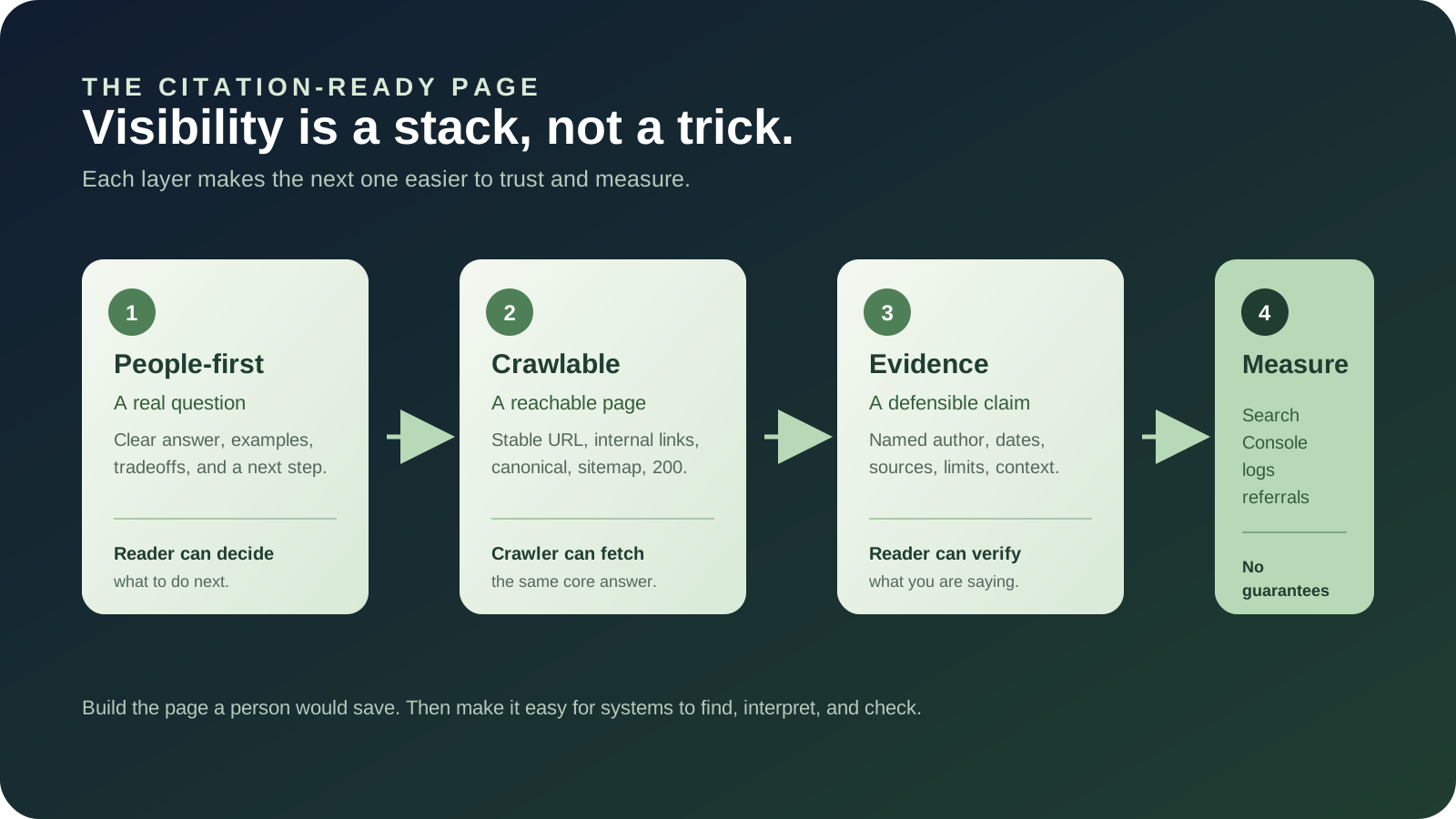
My practical model is a citation-ready page stack: people-first usefulness, crawlable delivery, explicit evidence, and honest measurement. This article explains each layer, what it can and cannot do, and a small implementation plan you can use without turning your site into a science project.
The short answer: build the page a person would save
A page becomes more useful to an answer engine when it already does the hard work for a reader. It should answer a specific question directly, explain terms before using them, show its reasoning, name its limits, and give the reader a next step. It should also have a stable URL that a crawler can reach and a source trail that lets someone check the important claims.
Here is the stack:
- People-first: the page solves a real decision instead of paraphrasing a keyword.
- Crawlable: the page is public, returns successfully, is linked internally, and is not accidentally blocked.
- Interpretable: the title, headings, metadata, canonical URL, and structured data agree with what the reader sees.
- Evidence-backed: time-sensitive facts have first-party sources, dates, context, and limitations.
- Measurable: you watch indexing, search impressions, referrals, server logs, and citations where those signals are available, without pretending they are the same metric.
None of these layers guarantees a citation. Google explicitly says that eligibility does not guarantee crawling, indexing, or serving. AI answers vary by query, model, location, freshness, and the pages available at the moment. The goal is to improve the conditions for useful discovery, not to promise an outcome no publisher controls.
What AI search is actually doing
“AI search” is a broad label. It can mean an AI Overview inside a conventional search page, an exploratory answer mode, a chatbot that browses on a user’s behalf, or a product-specific assistant that retrieves documents from a private index. These systems do not all use the same crawler, ranking system, context window, or citation policy.
Google’s public documentation describes AI Overviews and AI Mode as features that can surface links to supporting websites. It also says they may use a “query fan-out” technique: the system issues multiple related searches across subtopics or data sources before composing a response. That detail changes how you should write. A page should not only contain one exact answer. It should make the relationships around that answer clear.
For example, a reader may ask, “How do I make my service business visible in AI search?” A useful answer may require several connected facts:
- What the service actually is and who it is for.
- Which pages explain the service, process, location, and proof.
- Whether those pages are public and crawlable.
- Whether the claims are current and supported.
- What the reader should do if the service fits.
A thin page that repeats “AI search visibility” ten times does not answer those supporting questions. A clear page with a specific point of view, relevant internal links, and an honest source trail gives both people and systems more useful material to work with.
There is an important distinction here: being retrievable is not the same as being selected. A crawler may fetch a page that an answer engine never cites. A page may be indexed but not appear for the question you tested. A citation may bring no click. Treat each stage as a separate condition rather than one giant “visibility” score.
Layer one: people-first content beats bot-facing copy
Google’s people-first guidance is not a decorative brand statement. It is a useful editing test. Is the page made primarily to help someone, or primarily to create more chances to appear for a phrase? If you removed the search traffic, would the page still be worth reading?
For a practical article, start with the reader’s job:
| Reader wording | Decision underneath | Useful page shape |
|---|---|---|
| How do I get cited by AI search? | What should I fix first? | A prioritized audit with limits and verification steps. |
| Does my business need an AI-readable website? | Is this a real project or a gimmick? | A plain-English explanation of crawlability, content, and measurement. |
Should I create an llms.txt file? | Will this help more than fixing the site? | A comparison that separates documented controls from experiments. |
| Why is my page indexed but not mentioned? | Which part of the visibility chain is weak? | A failure-mode map: access, relevance, evidence, or selection. |
Notice what this approach avoids. It avoids a page called “The Ultimate AI Search Optimization Guide” that gives the reader no decision, no order of operations, and no boundary around what is known. It also avoids creating separate pages for every tiny wording variation when one genuinely useful guide could cover the question and link to a deeper service or technical page.
People-first writing has a practical structure:
- Give the direct answer near the top.
- Define the important terms in normal language.
- Use headings that describe the reader’s questions, not your internal campaign labels.
- Show a concrete example or failure mode.
- Separate facts, your synthesis, and predictions.
- Say what you do not know.
- End with a useful action, not a vague promise.
This is also a defense against accidental overclaiming. When you write for a real person who must make a decision, it becomes harder to hide behind words such as “optimize,” “dominate,” or “guarantee.”
Layer two: make the page easy to fetch
Before an answer engine can interpret a page, it needs to retrieve it. That sounds obvious, but many discoverability problems are mundane: a route is not linked from anywhere, a deployment is serving an old version, a canonical points to another page, a robots rule blocks a crawler, or the content only appears after a fragile client-side interaction.
Start with a simple fetch checklist:
- Request the exact production URL and confirm the expected HTTP status.
- Confirm the public title and the main answer appear in the returned document.
- Check that the route is linked from a relevant hub or neighboring page.
- Check the canonical URL and make sure it matches the intended public URL.
- Check the sitemap and confirm the page is included when your site uses one.
- Inspect
robots.txtand any page-level noindex directive. - Review server logs for crawler requests when those logs are available.
Google describes a sitemap as a file that tells search engines about pages and the relationships between them. It can help discovery, but it does not guarantee that every URL will be crawled or indexed. That is the right mental model: a sitemap is a useful signpost, not an admission ticket.
Internal links matter for the same reason. A new article linked from the relevant hub is easier for a crawler and a reader to discover than an orphaned page that exists only because someone knows the URL. Link the page from a collection, from at least one closely related article, and from the page that introduces the broader topic. Use descriptive anchor text so the relationship is clear without the surrounding paragraph.
For a Next.js site, server-rendered article text is a sensible default for important content. Client-side enhancement is fine for navigation, filters, and interactive examples, but the core answer should not disappear when JavaScript is delayed or a crawler chooses a different rendering path.
Robots rules are controls, not ranking hacks
Robots directives answer a permission question: which automated systems may access which content? They do not tell an answer engine that your page is authoritative. OpenAI’s crawler documentation is unusually clear about the distinction between its bots. OAI-SearchBot is used to surface websites in ChatGPT search; GPTBot is used for content that may help train foundation models; ChatGPT-User is tied to user-triggered visits and is not the automatic search crawler.
That separation is useful because your policy may reasonably differ by purpose. A publisher might allow search discovery while declining model-training crawling, or allow neither. The important part is to make the choice intentionally, keep the rules consistent with your privacy and licensing position, and verify the behavior in logs after changing them. Do not assume that adding an unfamiliar user-agent line creates more visibility.
Layer three: make the page easy to interpret
Clear structure helps a reader skim, but it also gives software explicit clues about what the page is. Use one descriptive H1. Put the central promise in the opening paragraphs. Use H2s for the major questions. Keep tables and lists tied to a decision. Make links describe their destination.
Metadata is part of that contract. A title should describe the page rather than advertise a campaign. A meta description should summarize the real benefit. A canonical should identify the preferred URL. Open Graph information should not promise a different article than the visible page. If you use an image, its alt text should explain the information it carries, not merely say “AI graphic.”
Structured data can help search systems understand page content. Google describes it as a standardized format for providing information about a page and classifying its content. But Google also says not to add structured data about information that is not visible to users. Schema is a description of the page, not a place to smuggle in claims, keywords, or a second version of the story.
For a long-form article, Article, WebPage, and BreadcrumbList entities are reasonable descriptive choices when they accurately match the rendered route. FAQ markup is appropriate only when the questions and answers are visibly present and genuinely useful. The presence of JSON-LD may improve machine interpretation, but it is not a guarantee of a rich result, a citation, or a ranking change.
Think of the page as having one canonical story:
| Surface | What should agree | Common failure |
|---|---|---|
| H1 and opening | Reader question and page promise | Title says “how to fix” while the page only defines terms. |
| Metadata | Visible title, audience, and scope | Meta copy promises a result the article never supports. |
| Canonical | Preferred public URL | Trailing slash, host, or legacy path points elsewhere. |
| Schema | Visible article, author, dates, FAQ, and breadcrumbs | Hidden claims or outdated dates are marked up. |
| Sitemap and links | Same route as the canonical | The page is listed under a staging or legacy URL. |
Layer four: make claims easy to check
Answer engines need more than fluent sentences. The page should help a skeptical reader distinguish what is documented, what you observed, and what you infer.
A useful source trail has at least four properties:
- Proximity: the source is close to the claim it supports, not hidden in a giant undifferentiated bibliography.
- Authority: the source is first-party documentation, a standards body, a paper, a security advisory, or clearly labeled community evidence when that is what you have.
- Freshness: the page records when a time-sensitive source was published or updated and when you checked it.
- Scope: the wording does not stretch a narrow source into a universal conclusion.
For example, OpenAI’s crawler page supports a specific statement about the roles of OAI-SearchBot, GPTBot, and ChatGPT-User. It does not support the claim that allowing OAI-SearchBot will make a website appear in every ChatGPT answer. Google’s AI features page supports the idea that normal indexing eligibility remains important. It does not support the claim that a particular heading pattern will win an AI citation.
Community discussions are useful for finding confusion and product gaps, but they are not the same as official documentation. A public PostHog issue asks for first-class reporting around AI referrals, bot activity, and citations. A public WooCommerce POS issue discusses how a team might measure AI-search visibility through query sampling, citation tracking, Search Console, and referral patterns. Those pages are signals about what practitioners are trying to understand. They are not representative surveys, and they should not be rewritten as market statistics.
This distinction is a competitive advantage. Many articles repeat a vendor’s preferred vocabulary as if it were a universal standard. A careful page says, “Here is what the documentation establishes. Here is what practitioners are asking for. Here is my recommendation based on the gap.” That is more trustworthy and more useful.
What about llms.txt and other special files?
Machine-readable files can be useful in a specific context, but they are often promoted far beyond what the evidence supports. Google’s current AI features guidance says publishers do not need to create new machine-readable files, AI text files, or special markup to appear in AI Overviews or AI Mode. It points publishers back to foundational SEO and people-first content.
That does not make every alternative file pointless. A well-maintained plain-text index may help a human or an internal tool find a site’s important pages. A documentation site may choose to publish a concise map for its own users. A robots policy is important when you need crawler control. A sitemap is useful for URL discovery. These are different jobs.
Use a simple test before adding a new file:
- What exact problem does this file solve?
- Which documented consumer reads it?
- What will be wrong if it becomes stale?
- Does it duplicate a better-supported surface such as navigation, sitemap, or page metadata?
- Can you verify that it is being fetched or used?
If the answer is “it might help AI systems understand my site,” that is an experiment, not a proven requirement. Label it internally as an experiment, keep it accurate, and do not let it distract from the page itself. A stale special file can create a second, contradictory description of your business.
Why a page can be indexed but not cited
“It is in Google” and “an answer engine mentioned it” are related but different observations. When a page does not appear in an answer, work through the failure modes instead of immediately rewriting the whole article.
| Symptom | Likely layer | Next check |
|---|---|---|
| The URL returns 404 or redirects unexpectedly. | Delivery | Inspect the production route, deployment, and redirect chain. |
| The page is not in the sitemap or linked from the hub. | Discovery | Add the smallest correct internal link or sitemap coverage. |
| The page is indexed but answers a different question. | Relevance | Rewrite the opening, H1, headings, and examples around the reader job. |
| The main claims have no dates or sources. | Evidence | Add first-party citations and narrow the wording. |
| The page is one of many near-duplicates. | Consolidation | Choose a canonical page and link supporting pages to it. |
| One test query returns no citation. | Selection variance | Test a small set of natural questions over time; do not infer a universal failure. |
There is also a source-fit problem. An answer engine may prefer a first-party manual for a product-specific question, an official standard for a protocol question, or a practical comparison for a decision question. You cannot make one page the best source for every angle. Build a small connected library where each page has a clear job and points to the others.
If the wider topic is agentic AI, the same rule applies. An agentic AI guide can explain the difference between a workflow and an agent, while this page handles the discovery and evidence layer. A security page can then cover permissions and prompt injection. That is better than forcing one giant article to answer every question. Good internal linking gives each page a job, gives readers a sensible next step, and helps a crawler understand that the pages belong to one useful subject area.
Finally, some answers simply do not need your page. The system may answer from a stronger source, from its own product data, or from information that is not available to you. That is normal. Discoverability work should make your page more useful, not turn uncertainty into a promise.
How to measure without fooling yourself
AI-search measurement is still fragmented. You may have Search Console data, web analytics, server logs, referral URLs, crawler user-agent records, and third-party citation monitoring. These measures answer different questions.
- Indexing: has the search engine discovered and indexed the URL?
- Search demand: does the page receive impressions or clicks for relevant queries?
- Crawler access: are documented search bots reaching the page?
- Referral traffic: did a visitor arrive from an AI assistant or answer surface?
- Citation presence: does a sampled answer link to the page for a defined query set?
- Business outcome: did a qualified reader take the action the page is meant to support?
Do not add these into one impressive-looking score unless you can explain exactly what it means. A crawler hit is not a citation. A citation is not a click. A click is not a qualified consultation. A consultation is not a signed project.
A low-maintenance measurement plan can be enough:
- Keep a list of 10–20 natural questions your target reader might ask.
- Record the page that should answer each question and the sources that support it.
- Check Search Console for impressions and queries after the page has had time to settle.
- Review analytics for referrals from known AI surfaces, with the limitation that referrers may be missing.
- Review server logs for crawler access, respecting privacy and retention rules.
- Sample the questions periodically and record whether your page is cited, what wording is used, and which competitors or sources appear.
- Look for qualified actions, not just visibility.
Keep the sample stable enough to compare, but do not treat it as a scientific estimate of the entire answer-engine ecosystem. Models, indexes, prompts, locations, and interfaces change. The useful output is a learning loop: which questions are clear, which pages are trusted, where the source trail is weak, and what readers do next.
A practical 30-day plan
You do not need a site-wide rewrite to improve discoverability. Start with one important topic and one page that can become the best answer you can responsibly publish.
Days 1–5: choose the page and the reader job
- Pick one real question connected to your product, service, or expertise.
- Write the direct answer in two or three paragraphs.
- List the supporting questions that a reader will ask next.
- Define non-claims: what you will not promise or imply.
- Collect at least five first-party or primary sources for current facts.
- Collect public discussions only as qualitative signals about confusion or workflow pain.
Days 6–12: draft the useful version
- Use a descriptive H1 and headings that match the reader’s questions.
- Include one decision table, checklist, comparison, or diagram when it clarifies a relationship.
- Explain tradeoffs and failure modes, not just the happy path.
- Put citations near important time-sensitive claims.
- Label inferences and predictions as such.
- Add a clear next step that matches the reader’s intent.
Days 13–18: make the page technically coherent
- Use a stable route and a self-referencing canonical.
- Add the route to the relevant hub and at least one related article.
- Confirm sitemap coverage.
- Check robots rules and page-level indexing directives.
- Add accurate Article, WebPage, and BreadcrumbList schema when appropriate.
- Make sure structured data and metadata describe visible content.
- Request the exact route, hub, and sitemap in a browser or HTTP client.
Days 19–30: measure and improve the weakest layer
Do not make five changes at once and then declare victory. Record the initial state, let the page be crawled, and look for evidence. If the page is not reachable, fix delivery. If it is reachable but unclear, fix the content. If it is clear but unsupported, improve sources. If it is indexed and well-supported but not cited in one test, expand the sample before drawing a conclusion.
This order saves time because it prevents “AI optimization” from becoming a ritual of endless rewriting. You are improving a system with observable conditions.
What I would not do
I would not publish dozens of thin pages that answer the same question with different adjectives. I would not hide keywords in metadata or schema. I would not claim that an llms.txt file is required when the relevant search documentation says it is not. I would not use a citation screenshot as proof of market demand. I would not treat a crawler request as evidence that a page was selected. I would not promise that a technical change will create traffic, rankings, or leads.
I would also avoid making the site sound like it was written for an answer engine. Readers notice when every paragraph begins with a definition and ends with a keyword. Write with a point of view. Use examples from the real decision. Let the page say “this is a good fit when…” and “do not use this when…” Those boundaries make the content more useful than generic certainty.
The best discoverability work is usually a product of good editorial judgment and basic technical hygiene. That may sound less exciting than a new optimization acronym, but it is far more durable.
The same principle should guide evaluation. A page is not “working” because a model praised it once. Define a small workflow: publish, request the route, confirm the canonical and sitemap, watch indexing, sample representative questions, and inspect the resulting referral or consultation path. If the evidence changes, update the page. That is a healthier loop than optimizing for a screenshot.
FAQ
Do I need special AI SEO markup?
Not according to Google’s current guidance for AI Overviews and AI Mode. The documented path is normal search eligibility, technical accessibility, helpful content, and standard SEO practices. Structured data can help describe visible content, but there is no special schema that guarantees AI inclusion.
Does llms.txt help?
It may be a useful site index in some workflows, but there is no basis for treating it as a universal requirement or guaranteed ranking signal. Add it only when you can name the consumer and keep it accurate. Fix navigation, source quality, canonicalization, and crawlability first.
Should I allow OpenAI crawlers?
That is a policy decision. If you want a chance to appear in ChatGPT search, OpenAI says to allow OAI-SearchBot. You can make a different choice for GPTBot, which OpenAI describes as a training crawler. Review your licensing, privacy, and business position before changing robots rules.
How long until I see results?
There is no reliable universal timeline. Google says changes can take from hours to months and recommends evaluating work over time. Search Console, logs, referrals, and sampled citations can show different stages of the process. Treat early observations as signals, not proof of a permanent change.
Can BishopTech help make this practical?
Yes. If you have a service, workflow, or product idea that needs to become clearer and easier to discover, start with a consultation. The useful first step is usually to map the reader question, the page that should answer it, the technical gaps, and the evidence you will use to judge progress.
Sources and further reading
This article was checked against the following public documentation and practitioner discussions on August 12, 2026. Official documentation supports the technical claims; community pages are included as qualitative signals about measurement questions, not as representative statistics.
- Google Search Central: AI features and your website — AI Overviews, AI Mode, query fan-out, eligibility, measurement, and the statement that no special AI markup is required.
- Google Search Central: Creating helpful, reliable, people-first content — people-first content, trust, authorship, and avoiding search-engine-first writing.
- Google Search Central: Learn about sitemaps — sitemap purpose, discovery, and the limitation that inclusion does not guarantee crawling or indexing.
- Google Search Central: Canonical URLs — redirects, rel=canonical, sitemap signals, and duplicate URL handling.
- Google Search Central: Introduction to structured data — describing visible page content and structured-data quality guidance.
- OpenAI: Overview of OpenAI crawlers — the separate roles of OAI-SearchBot, GPTBot, OAI-AdsBot, and ChatGPT-User.
- PostHog issue #71889: Web analytics and AI visibility — a public practitioner request connecting AI referrals, bot activity, and citations.
- WCPOS issue #599: How we measure AI-search visibility — a public discussion of query sampling, citation tracking, Search Console, and referral patterns.
The evidence is moving. The durable part is the method: publish something useful, make it reachable, show your work, and measure each stage honestly.